


Israel is small enough that the Mediterranean Sea remains a daily point of geographic reference, yet varied enough that a short journey inland alters the country’s climate, ecology, and civic rhythms. Urban centers line the Mediterranean coastal plain; limestone ridges ascend eastward toward Jerusalem; farther south, the Negev opens into hyper-arid highlands, gravel plains, and dramatic erosion cirques. Water connects these compact landscapes, but it also reflects how physical geography intersects with regional geopolitics: stored in natural aquifers, desalinated along coastal dunes, recycled for agriculture, and contested across borders that remain subject to international dispute.[1][2]
Approaching Israel requires understanding several overlapping political and social maps. One is the sovereign state established in 1948, with Hebrew as its official language, a parliamentary democracy, and Jewish national self-determination established within its constitutional framework.[5][23][27] Another is the shared home of more than two million Arab citizens—comprising Muslim, Christian, Druze, and Bedouin communities—whose distinct histories, cultural identities, and civil standing are integral to the country’s social fabric.[4][14][25][26] Bordering and intertwined with these boundaries lies the occupied Palestinian territory—encompassing the West Bank, East Jerusalem, and the Gaza Strip—whose population, territorial governance, and unresolved political status cannot be conflated with Israel’s domestic profile, yet whose lives remain deeply entangled through military control, security barriers, and international law.[8][9][10][22]
Coastal plains, rift valleys and water geography
From the Mediterranean coast, Israel’s topography climbs eastward across a narrow coastal plain into the central Judean and Samarian hills before dropping precipitously into the Great Rift Valley, a vast tectonic trench that cleaves the Levant.[1][3] Along this tectonic corridor lie the country’s primary freshwater reservoirs and inland waters: the Sea of Galilee (Lake Kinneret), the Jordan River, and the hypersaline Dead Sea, which sits at more than 430 meters below sea level as the lowest exposed land elevation on the planet.[1][3]

The Sea of Galilee, situated beneath the basalt bluffs of the Golan Heights, has served for centuries as a vital source of surface drinking water and artisanal fishing.[1][15] In the 1960s, the construction of the National Water Carrier tapped the Kinneret to convey fresh water through massive pipelines to coastal cities and southern agricultural settlements.[15][16] Because the Jordan River basin is shared between Israel, Jordan, Syria, Lebanon, and the Palestinian territories, equitable transboundary water allocation remains a critical diplomatic challenge.[16][35] In response to recurring droughts and groundwater depletion, Israel pioneered large-scale reverse-osmosis seawater desalination along the Mediterranean at Sorek, Hadera, and Ashkelon, which now generate more than eighty percent of municipal domestic water supplies, alongside sophisticated wastewater reclamation systems that treat over eighty-five percent of domestic effluent for crop irrigation.[2][15]
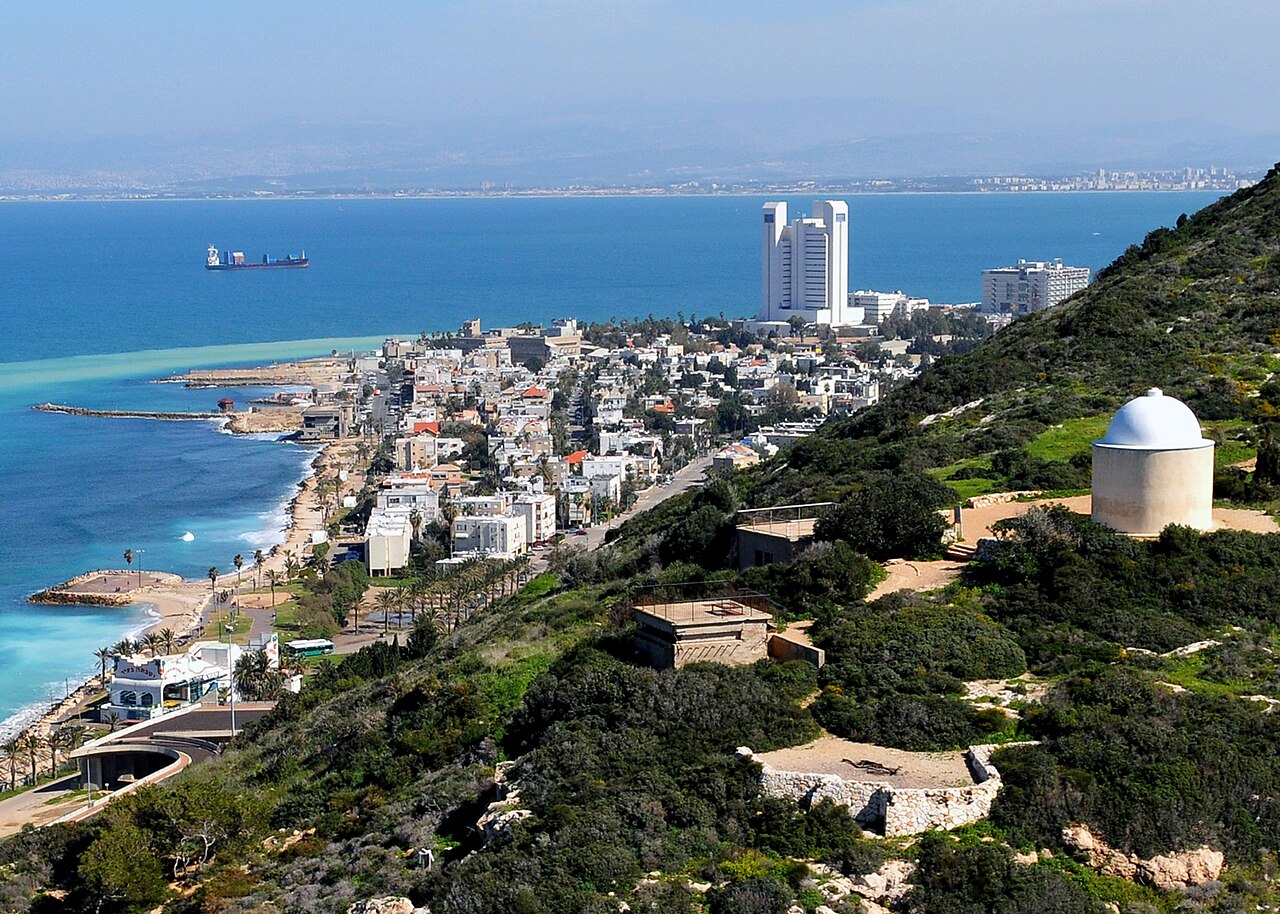
North of the Kinneret, the Galilee features verdant hills, ancient olive groves, and mixed Jewish and Arab towns like Nazareth and Sakhnin, climbing toward Mount Meron.[1][4] On the coast, the port city of Haifa descends in graceful terraces from the wooded crest of Mount Carmel to a natural deep-water bay, where the gilded shrine of the Bahá’í World Centre overlooks busy commercial container terminals, the Technion research institute, and mixed residential quarters such as Wadi Nisnas.[4][11] Along the Carmel ridge, Mediterranean macchia oak and pine forests shelter reintroduced Persian fallow deer, while coastal plains south of Haifa nurture heritage vineyards established during late nineteenth-century agricultural settlements at Zikhron Ya’akov and Binyamina.[1][4] Farther south, the metropolitan core of Gush Dan, centered on Tel Aviv-Yafo, forms an energetic economic corridor of corporate towers, software enterprises, Bauhaus architectural boulevards in the UNESCO-listed White City, and Mediterranean public beaches.[4][37]
The southern half of the country is dominated by the Negev Desert, an arid expanse of rocky plateaus, gravel washes (*wadis*), and massive erosion cirques known as *makhteshim*, exemplified by the forty-kilometer chasm of Makhtesh Ramon.[1][3] In the Arava Valley along the Jordanian border, date palm plantations and greenhouses flourish using brackish groundwater and solar arrays, while ancient copper workings at Timna Valley bear witness to Egyptian and Midianite mining expeditions dating back three millennia.[1][3] Beersheba anchors the northern Negev as an administrative and university hub, while the region also encompasses dozens of recognized and unrecognized Bedouin Arab villages whose residents contend with complex state planning policies, historic land claims, and municipal infrastructure access.[13][14] At the southernmost tip, the resort and port town of Eilat provides a strategic maritime gateway to the Gulf of Aqaba and the Red Sea, connecting Israel directly to Afro-Asian shipping lanes.[1] To the northeast, the Golan Heights—captured from Syria in the 1967 war and effectively annexed under Israeli domestic law in 1981—remains occupied territory under United Nations Security Council Resolution 497, characterized by basalt volcanic plateaus, vineyards, and Druze communities.[34]
Jerusalem: sacred topography and contested sovereignty
Perched upon an upland limestone watershed in the Judean Mountains, Jerusalem represents one of humanity’s oldest continually inhabited cities, sacred to Judaism, Christianity, and Islam.[10][12] Within the Ottoman-era stone walls of the Old City, four historic quarters—Jewish, Muslim, Christian, and Armenian—crowd together around sites of profound spiritual devotion: the Western Wall, the surviving retaining wall of the Second Temple; the Dome of the Rock and Al-Aqsa Mosque atop the noble sanctuary (*Haram al-Sharif*); and the Church of the Holy Sepulchre, commemorating the crucifixion and resurrection of Jesus.[10][12]

Jerusalem is equally a modern, growing city of government ministries, the Knesset (parliament), Hadassah Medical Center, the Hebrew University, open-air markets like Mahane Yehuda, and active commuter light-rail corridors.[4][30] Israel claims Jerusalem, complete and undivided, as its sovereign capital under the 1980 Basic Law: Jerusalem.[12] However, the international community, including the United Nations and the International Court of Justice, does not recognize Israeli sovereignty over East Jerusalem, which was captured in 1967, regarding it as occupied territory whose ultimate status must be resolved through bilateral negotiations alongside the wider Israeli-Palestinian conflict.[10][12][22] For Palestinian residents of East Jerusalem, daily life involves navigating distinct residency permits, urban zoning restrictions, and security checkpoints that separate them from neighboring West Bank communities.[10][12]
Zionism, the founding of the state and the Nakba
Modern Israeli statehood emerged from the late nineteenth-century rise of political Zionism in Europe, articulated by Austro-Hungarian journalist Theodor Herzl in his 1896 treatise *Der Judenstaat* (“The Jewish State”).[6][7] In response to rising anti-Semitic pogroms across Tsarist Russia and widespread discrimination in Europe, Zionist organizations advocated for the re-establishment of a self-governing Jewish national homeland in Palestine, the ancient ancestral land of Israel (*Eretz Yisrael*).[6][7] Successive waves of Jewish immigration (*Aliyah*) under late Ottoman rule and the British Mandate established agricultural settlements, kibbutzim, and civic institutions.[6][9]
The catastrophic genocide of European Jewry during the Holocaust—in which Nazi Germany murdered six million Jews—galvanized international support for Jewish sovereignty and created an urgent postwar refugee crisis across European displaced persons camps.[6][19] In November 1947, the United Nations General Assembly adopted Resolution 181, recommending the partition of Mandatory Palestine into independent Jewish and Arab states with an international regime for Jerusalem.[9][21] While Zionist leaders accepted the partition framework, Arab leaders and neighboring states rejected it, viewing the division of Palestine as fundamentally unjust to the indigenous Arab majority.[8][9]
On 14 May 1948, following the expiration of the British Mandate, David Ben-Gurion proclaimed the establishment of the State of Israel, swiftly receiving diplomatic recognition from the United States and the Soviet Union.[5][19] The declaration triggered the 1948 Arab-Israeli War, involving armies from neighboring Arab nations.[5][9] For Palestinians, this period is remembered as the *Nakba* (“Catastrophe”), during which more than 700,000 Palestinian Arabs were expelled or fled from their homes, hundreds of villages were depopulated, and communities were fractured into an enduring worldwide diaspora and refugee population.[8][9][20] Following the 1949 armistice agreements, armistice lines known as the Green Line demarcated Israel’s borders until the Six-Day War of 1967, when Israel occupied the West Bank, East Jerusalem, Gaza, the Sinai Peninsula, and the Golan Heights.[9][21]
Linguistic revival and a diverse demographic mosaic
One of the notable cultural achievements of modern Israel was the revival of Hebrew as a living spoken vernacular. For nearly two millennia following the Roman exile, Hebrew survived primarily as a sacred liturgical and literary language across Jewish diaspora communities.[18] Spearheaded by linguist Eliezer Ben-Yehuda in the late nineteenth and early twentieth centuries, modern Hebrew was systematically adapted with new vocabulary for contemporary science, politics, and daily life, becoming the common mother tongue uniting immigrants from over one hundred countries.[18][24]
Israel’s population of nearly ten million reflects wide cultural and demographic variety. The Jewish population includes Ashkenazi Jews of European heritage, Sephardi Jews from the Mediterranean and Iberian diaspora, Mizrahi Jews from the Middle East and North Africa (including Iraq, Yemen, and Morocco), Beta Israel communities from Ethiopia, and more than one million Russian-speaking immigrants who arrived following the collapse of the Soviet Union.[4][19][24]
Arab citizens of Israel constitute more than twenty percent of the population, forming a dynamic and complex demographic.[4][14] The vast majority are Sunni Muslims residing across the Galilee, the central Triangle region, and the Negev.[14][25] Christian Arabs, centered primarily in Nazareth, Haifa, and Shefa-‘Amr, maintain ancient Eastern Orthodox, Melkite Greek Catholic, and Latin parishes.[26] The Arabic-speaking Druze community in the Carmel and Galilee hills maintains a distinct esoteric religious tradition and strong civic integration, including compulsory service in the Israel Defense Forces.[4][14] In 2018, the Knesset passed the Basic Law: Israel as the Nation-State of the Jewish People, which codified Hebrew as the sole state language and designated Jewish settlement as a national value, while assigning Arabic a ‘special status,’ sparking extensive constitutional debate regarding civil equality and minority representation.[23][27]
Everyday culture, culinary crosscurrents and economic dynamism
At home and in public street markets, Israeli cooking reflects an intricate fusion of Middle Eastern, Mediterranean, and European foodways. Rather than a singular culinary tradition, daily food is defined by crosscurrents: Levantine staples such as hummus, tahini, falafel, chopped tomato-cucumber salad, and freshly baked pita exist alongside dishes introduced by immigrant waves.[28][29] Yemenite Jews popularized flaky *malawach* and *jachnun* pastry breads; North African immigrants introduced *shakshuka*, eggs poached in a spicy tomato and pepper stew; Iraqi Jews brought *sabich*, a pita sandwich stuffed with fried eggplant, hard-boiled eggs, and pickled mango sauce (*amba*); and Central European immigrants brought schnitzel and braided challah.[28][29] On Friday afternoons before the commencement of the Jewish Sabbath (*Shabbat*), lively open-air bazaars empty as families gather for festive dinners, observing calendar rituals that mark the passage of seasons from Hanukkah jelly doughnuts (*sufganiyot*) to spring Passover feasts.[4][28]
In rural areas, communal agricultural ideals gave birth to the *kibbutz*, an egalitarian collective settlement where members shared property, meals, and agricultural labor, and the *moshav*, a cooperative village of private family smallholdings.[38][39] While early kibbutzim formed the backbone of pioneering desert reclamation and frontier defense, most have privatized over recent decades, transitioning toward differentiated wages, high-tech manufacturing, and specialized agricultural exports.[38][39] Pioneering agricultural research led to the invention of modern drip irrigation by Simcha Blass in the 1960s, allowing arid farms in the Negev and Arava to produce high-yield tomatoes, peppers, and dates with minimal water consumption.[39]
Today, Israel possesses an advanced market economy characterized by high research and development spending. Often referred to as “Silicon Wadi,” the high-technology sector concentrated around Tel Aviv, Herzliya, and Haifa drives national economic growth, specializing in cybersecurity, artificial intelligence, medical devices, and clean energy.[4][37] However, OECD economic surveys indicate that the country faces substantial domestic socioeconomic disparities, with labor-market participation and income gaps particularly pronounced among the ultra-Orthodox (*Haredi*) Jewish community and Arab citizens.[37]
Regional conflict, humanitarian costs and future horizons
No portrait of Israel can overlook the deep fractures of ongoing conflict. The devastating attacks led by Hamas on 7 October 2023 killed approximately 1,200 people in southern Israel and resulted in 251 hostages being taken, inflicting acute national trauma and mourning across Israeli society.[31][32] The ensuing war waged by Israel in the Gaza Strip caused unprecedented civilian devastation, displacement of over two million Palestinians, severe humanitarian famine, and catastrophic loss of life, drawing proceedings before the International Court of Justice and the International Criminal Court regarding violations of international humanitarian law.[17][31][32][36]
Even amid fragile ceasefire negotiations, the humanitarian crisis in Gaza and escalating tensions across the West Bank, Lebanon, and the wider Middle East underscore the interconnectedness of the region’s peoples.[17][32][33][36] Following shared aquifers, electrical grids, and coastal waterways illustrates that geographic proximity cannot be severed by walls or checkpoints.[15][35] Israel endures as a nation of immense technological vitality, rich spiritual traditions, and deep internal diversity, perpetually navigating its identity between the shores of the Mediterranean, the deep rift of the Jordan, and the unresolved quest for lasting regional peace.[1][3][10][22][37]






Share what you know
Been there, grew up there, or know something we missed? Add a comment; corrections with a source are especially welcome.