


Barbados sits proud and solitary in the western Atlantic, positioned roughly one hundred and sixty kilometres east of the main volcanic arc of the Windward Islands. Facing the open swells of the Atlantic Ocean before meeting the Caribbean Sea, this easternmost outpost of the Lesser Antilles occupies an exceptional geographical and historical position. While neighboring volcanic islands feature steep volcanic cones and sulfurous calderas, Barbados is an uplifted coral-limestone island whose white terraces step gracefully down to turquoise shallows. For over three centuries, this modest, pear-shaped territory of 430 square kilometres served as the jewel of the British imperial plantation empire, pioneering large-scale sugarcane monoculture and African chattel slavery before forging an enduring tradition of parliamentary democracy. Today, having peacefully transitioned to a sovereign parliamentary republic, Barbados stands as an articulate global champion of climate justice, proving that small island statehood can wield profound moral authority across the world stage.[1][2][9]
An island sculpted from living coral and ocean swells
Unlike the volcanic peaks of Saint Lucia or Dominica, eighty-five percent of Barbados consists of a thick cap of Pleistocene coral limestone, deposited by ancient fringing reefs and progressively lifted above sea level by tectonic upwarping along the subduction zone of the Atlantic and Caribbean plates. This coral mantle rises in a succession of ancient marine terraces, culminating in the rolling interior tablelands. In the northeastern parishes of Saint Andrew and Saint Joseph, however, mechanical erosion has stripped away the limestone cap to reveal the rugged Scotland District. Here, steep amphitheaters of folded oceanic clays, sandstones, and mineral chalks tumble down toward the ocean, crowned by Mount Hillaby at 340 metres above sea level.[1][3]
This geological composition creates a stark coastal and environmental contrast. Along the windward eastern coast, Atlantic breakers—unbroken after crossing thousands of kilometres of open ocean—crash relentlessly against the undercut mushroom-shaped limestone boulders of Bathsheba and Cattlewash, creating the world-renowned ‘Soup Bowl’ surf break. By contrast, the sheltered leeward western and southern coasts present calm, tranquil Caribbean waters fringed by white carbonate sand beaches and healthy patch reefs.[1][3]
In the northwest, the coastal town of Speightstown—historically nicknamed ‘Little Bristol’ due to its active direct mercantile trade with the English port of Bristol—preserves seventeenth-century merchant architecture, two-storey overhanging balconies, and the interactive Arlington House Museum. Further south along the Platinum Coast lies Holetown, where the first English settlers disembarked, anchored today by the historic stone belltower of St. James Parish Church, among the oldest consecrated Anglican sanctuaries in the Western Hemisphere.[5][8]

Because the coral limestone is porous karst, surface rivers are virtually non-existent. Instead, torrential tropical rains filter rapidly through the limestone bedrock, undergoing natural micro-filtration as they descend into vast subterranean cavern networks, such as Harrison’s Cave with its crystallized stalactites and underground waterfalls. These underground streams feed pristine freshwater aquifers (*Ghyben-Herzberg sheetwater lenses*) that provide the nation’s tap water with natural purity. Yet this reliance on groundwater makes the island exceptionally vulnerable to prolonged seasonal droughts, marine storm surges, and saltwater intrusion, necessitating comprehensive coastal zone planning overseen by the Coastal Zone Management Unit.[1][3][17]
Sugar, chattel slavery and the long march to liberation
Before European arrival, indigenous Amerindian peoples—successively the Saladoid, Arawak, and Carib communities—settled coastal bays, harvesting conch and navigating ocean canoes between the South American mainland and the Antilles.[4][22] Portuguese navigators noted the island in the early sixteenth century, naming it *Os Barbados* (‘The Bearded Ones’), likely referencing the hanging aerial roots of native bearded fig trees (*Ficus citrifolia*). When English settlers landed in 1627 at Holetown aboard the *Olive Blossom*, they found the island largely uninhabited, rapidly claiming it for King James I.[5][8]
In the 1640s, Dutch merchants introduced sugarcane cultivation, boiling technology, and windmill grinding machinery, triggering the historic ‘Sugar Revolution’. Barbados became the pioneer prototype of the brutal Caribbean plantation model. To maximize yields of ‘white gold’, the British colonial plantocracy cleared virtually all native rainforests, replacing indigenous flora with sprawling sugarcane fields and importing hundreds of thousands of kidnapped enslaved Africans to perform grueling forced labor in fields and boiling houses. The island also developed the world’s oldest commercial rum industry: Mount Gay Distilleries, founded in the northern parish of Saint Lucy in 1703, continues continuous rum distillation from cane molasses using traditional copper pot stills.[20]
Resistance to enslavement was constant. On Easter Sunday, April 14, 1816, African-born ranger Bussa led the largest slave insurrection in Barbadian history (*Bussa’s Rebellion*). Mobilizing over four hundred freedom fighters across southeastern plantations to overthrow white planter rule, the uprising was suppressed with severe brutality, but it shattered the myth of docile servitude, galvanizing the British abolitionist movement that culminated in the Slavery Abolition Act of 1834.[7] Today, the colossal bronze Emancipation Statue—depicting Bussa snapping his heavy iron chains in defiance—stands at the ABC Highway roundabout as an eternal monument to African resilience and liberation.[5][7]
Bridgetown and the Garrison: democracy and coral architecture
At the southwestern corner of the island on Carlisle Bay sits Bridgetown, the national capital and commercial engine of the republic. Founded in 1628 and inscribed on the UNESCO World Heritage list alongside its historic Garrison, Bridgetown features an irregular, organic medieval street plan that contrasts sharply with the rigid Spanish grid cities of the Caribbean. At the civic heart of the city stand the Parliament Buildings, a magnificent Neo-Gothic coral-stone complex complete with clock tower, erected between 1870 and 1874. Barbados boasts the third-oldest continuous parliament in the Commonwealth, with its representative House of Assembly having first convened in 1639.[2][6][15]
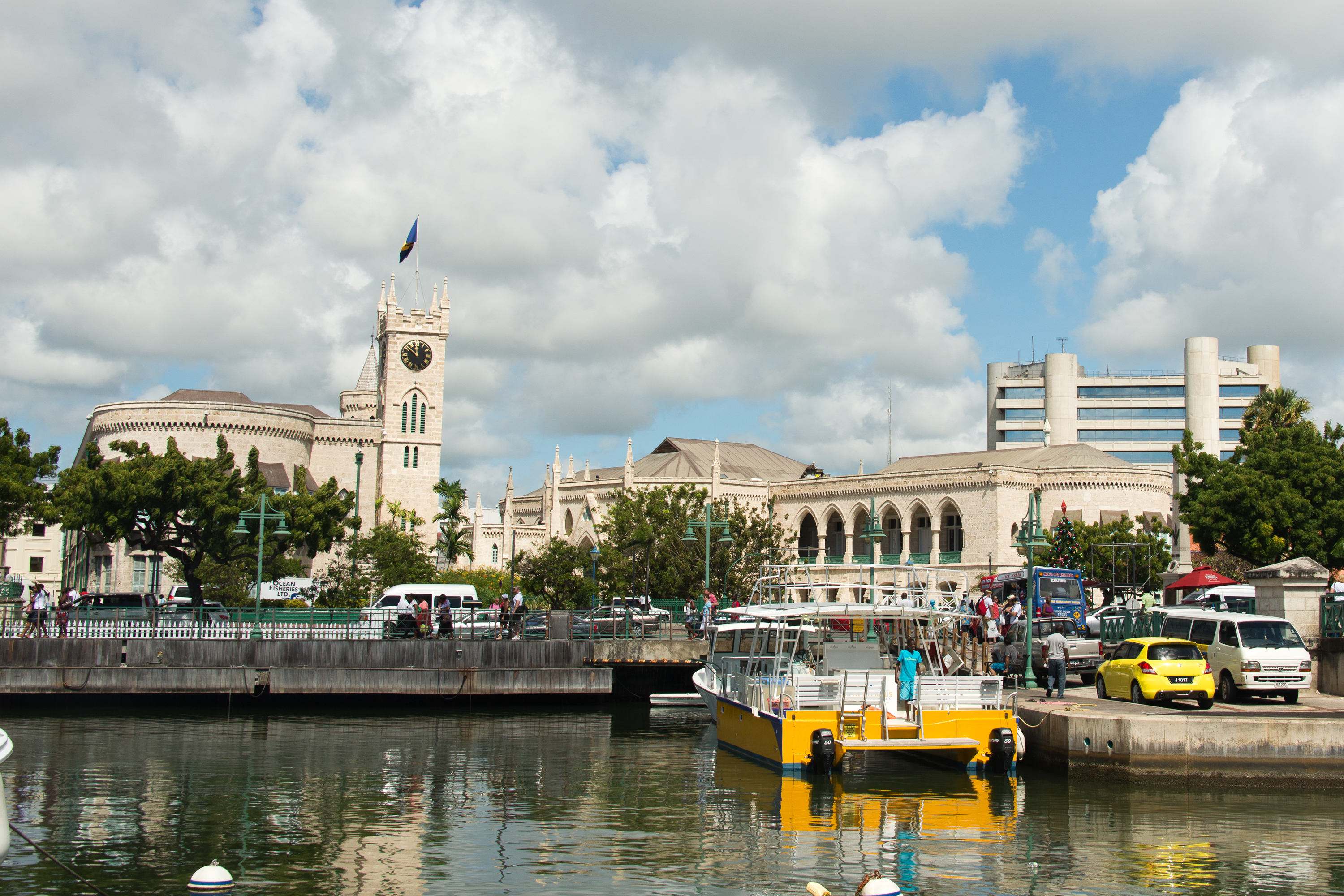
South of the capital, Saint Ann’s Garrison was established in 1780 as the premier British military headquarters for the Eastern Caribbean, featuring a massive savannah parade ground ringed by red-brick barracks, Victorian cannons, and the historic Bush Hill House where young George Washington convalesced in 1751 during his only journey outside North America.[2][6] In rural villages across the eleven parishes, folk vernacular architecture is immortalized in the traditional *chattel house*. Developed after emancipation, these elegant wooden cottages with high gabled roofs, symmetrical jalousie windows, and ornate fretwork gingerbread trim were engineered to be entirely modular: because formerly enslaved workers did not own the land they inhabited on plantation tenantries, the houses were set on dry coral blocks without foundation mortar, allowing them to be quickly dismantled, loaded onto ox carts, and reassembled on another plot.[6]
Democratic modern statehood emerged through twentieth-century labor movements led by national heroes Grantley Adams and Errol Walton Barrow. Barrow led the country to full national independence on November 30, 1966, establishing free secondary and university education, comprehensive healthcare, and the social safety net that created one of the most literate, stable societies in the Americas.[8][19] Fifty-five years later, on November 30, 2021, Barbados achieved a historic milestone by formally severing constitutional ties with the British Crown, swearing in Dame Sandra Mason as its first president and transitioning peacefully into a parliamentary republic under the inspirational leadership of Prime Minister Mia Mottley.[9][15]
Parallel to political sovereignty is an all-consuming national religion: cricket. For Barbadians, cricket is not merely a sport, but an arena of historical self-assertion and West Indian identity. Bridgetown’s Kensington Oval, affectionately termed the ‘Mecca of Caribbean cricket’, has hosted historic international test matches since 1895. Barbados has produced some of the greatest legends in cricket history: most notably Sir Garfield Sobers, widely celebrated as the greatest all-rounder of all time, alongside the celebrated ‘Three Ws’—Sir Frank Worrell, Sir Clyde Walcott, and Sir Everton Weekes—who broke colonial racial barriers to captain the West Indies to global dominance, and lethal fast bowlers like Malcolm Marshall and Sir Wesley Hall.[5][8]
Language, community rhythms and Crop Over
While English serves as the official administrative and academic language, the true cadence of daily Barbadian life is *Bajan*, an expressive English-lexified creole language. Developing through centuries of contact between English colonists, indentured Irish laborers, and diverse West African linguistic groups (predominantly Akan, Igbo, and Yoruba), Bajan possesses distinctive rhythmic tonal patterns, witty idioms, and concise grammatical structures. Sociolinguists document a fluid continuum where citizens move seamlessly between formal international English in corporate boardrooms and expressive Bajan in village rum shops and playing fields.[10][18]
The premier cultural showcase of national pride is *Crop Over*, the historic summer festival celebrated across July and August. Inscribed in national heritage records, Crop Over traces its origins to the 1780s, when the completion of the grueling sugarcane harvest on plantations was celebrated with communal feasts, parading the final cart of cane, and dancing to goatskin drums.[11][23] Re-established in 1974 by the National Cultural Foundation, modern Crop Over has grown into an international cultural festival uniting visual arts, culinary fairs, and the ceremonial delivery of the last canes honoring the most productive agricultural workers as the King and Queen of the crop.[11][12]
Musical competition forms the pulsating spine of Crop Over. Calypsonians and soca artists compete in fierce lyrical showdowns at the Pic-O-De-Crop and Party Monarch finals, composing infectious tracks that provide biting social commentary on domestic politics, economic justice, and Caribbean solidarity. The celebrations culminate on the first Monday in August with *Grand Kadooment*, an exhilarating masquerade parade where tens of thousands of revellers clad in breathtaking winged costumes of iridescent feathers, sequins, and beads dance down the Mighty Grynner Highway toward the sea, accompanied by mobile sound trucks pumping high-tempo soca.[11][12]
This creative eloquence is reflected in a rich literary and intellectual heritage that helped shape twentieth-century postcolonial consciousness. In his seminal 1953 novel *In the Castle of My Skin*, Barbadian author George Lamming captured the psychological complexities of childhood, colonial education, and communal transition in a changing plantation village. Poet and historian Edward Kamau Brathwaite pioneered the concept of ‘nation language’, celebrating the rhythm of Caribbean creole speech and African spiritual retentions. Today, the Barbados Museum & Historical Society at the Garrison preserves this multifaceted intellectual journey, documenting everything from indigenous pre-Columbian pottery to the social history of the sugar revolution in its Jubilee Gallery.[4][8]
Coastal heritage and the global climate frontier
Along the calm southern coastline in the parish of Christ Church, everyday Barbadian community life is intimately anchored to the sea. In towns like Oistins, generations of artisanal fishermen head out at dawn aboard wooden day-boats and modern ice-boats to fish deep offshore pelagic waters, returning in the late afternoon with silver catches of flying fish (*Hirundichthys affinis*), dolphin fish (mahi-mahi), yellowfin tuna, wahoo, and kingfish.[13][14]

On Friday and Saturday evenings, the Oistins Bay Garden transforms into the famous Oistins Fish Fry—an energetic communal gathering place where locals and visitors sit elbow-to-elbow at open-air picnic benches. Cooks grill seasoned swordfish, red snapper, and lobster over flaming coals, serving them with fried plantains, tossed salad, and fiery Bajan pepper sauce. The national culinary dish is *Cou-cou and Flying Fish*, an intricate preparation of steamed or fried flying fish fillets bathed in rich tomato, sweet pepper, and thyme gravy, served atop a smooth, buttery mound of cornmeal and okra paste turned patiently with a traditional flat wooden *cou-cou stick*.[14][18] Weekend family lunches are sealed with *Pudding and Souse*—steamed seasoned sweet potato pudding served alongside pickled pork belly marinated in lime juice, cucumbers, and fiery scotch bonnet peppers.[18]
Everyday social democracy thrives across the island’s more than one thousand village rum shops scattered across the eleven parishes. Distinctively painted in bright commercial brewery colors and wood trim, the Bajan rum shop functions as a neighborhood assembly hall, grocery dispensary, and debate forum. Here, fishermen, tradespeople, teachers, and politicians gather to slam domino tiles onto wooden tables with theatrical flair, debating national elections, cricket test scores, and world events over small flasks of local rum paired with cheese cutters, fish cakes, and ice water, embodying an unpretentious egalitarian civic culture.[5][18][20]
Yet this island economy—heavily reliant upon high-end tourism, financial services, and international hospitality—confronts acute modern environmental challenges. Rising sea surface temperatures, massive influxes of pelagic sargassum seaweed smothering coastal beaches, and increasingly intense Atlantic storms threaten delicate coral reef ecosystems and coastal infrastructure.[16][17][21] Under the international leadership of Prime Minister Mia Mottley, Barbados has become the global vanguard for climate adaptation financing. Mottley’s groundbreaking ‘Bridgetown Initiative’ challenges the international financial architecture, urging the World Bank and IMF to offer concessional climate loans, disaster pause clauses, and debt restructuring for climate-vulnerable developing nations.[9][16] Grounded in its coral rock, dignified by its democratic institutions, and united by the irrepressible spirit of its people, Barbados continues to punch far above its geographical weight, illuminating the path toward a more equitable and resilient global future.[2][9][15]






Share what you know
Been there, grew up there, or know something we missed? Add a comment; corrections with a source are especially welcome.