


Straddling the turbulent boundary where the North American and Eurasian tectonic plates diverge at a rate of approximately two centimeters per year, Iceland (Ísland) emerges from the cold waters of the North Atlantic like a freshly forged terrestrial laboratory. Covering one hundred and three thousand square kilometers just touching the Arctic Circle, this volcanic island represents one of the youngest geological landmasses on Earth. Formed roughly twenty million years ago by the coincidence of the Mid-Atlantic Ridge and a deep-seated mantle plume (the Iceland hotspot), the island is an elemental theater of volcanic rift valleys, vast calderas, geothermal fumaroles, and sprawling ice caps. More than ten percent of the national territory is permanently buried beneath glacial ice, while over thirty active volcanic systems regularly reshape the topography with basalt lava flows, ash falls, and catastrophic subglacial outburst floods known as jökulhlaups.
Yet Iceland’s identity is defined as deeply by human memory as by geophysics. Settled during the late ninth century by Norse pioneers and Celtic captives who crossed stormy northern seas from Norway, Scotland, and Ireland, Iceland established an egalitarian commonwealth without kings, standing armies, or feudal nobility. At the open-air assembly of Þingvellir, free farmers gathered every summer beneath the basalt cliff walls of the tectonic rift to recite laws, resolve disputes, and maintain an unbroken parliamentary democracy. In the isolated farmsteads of the western fjords, medieval storytellers transcribed the Icelandic sagas—monumental prose epics chronicling blood feuds, voyages across uncharted oceans, and human tragedy in an unyielding northern climate, composed in an ancient Germanic tongue so carefully conserved that modern Icelandic schoolchildren can read twelfth-century vellum manuscripts with effortless fluency.
The Tectonic Theater: Þingvellir, Gullfoss, and Geysir
In the southwestern interior lies the Golden Circle, a geographic triangle encompassing three of the country’s most celebrated geological landmarks. At Þingvellir National Park, designated a UNESCO World Heritage site, the planetary rift between tectonic plates is visible to the naked human eye. Massive chasms, fissures, and fault scarps tear through the basalt plains, most dramatically at the Almannagjá fault, where a vertical rock wall marks the eastern edge of the North American tectonic plate. The valley floor between the plates is sinking and widening continuously, opening deep freshwater fissures like Silfra, where glacial meltwater filtered through underground porous lava for thirty to one hundred years achieves underwater visibility exceeding one hundred meters.

It was at Þingvellir that the Alþingi (General Assembly) was established in 930 CE. Here, at the Lögberg (Law Rock), an elevated natural acoustic promontory backed by vertical basalt cliffs that projected sound outward across the gathered crowds, the elected Lawspeaker (lögsögumaður) stood to recite one-third of the nation’s unwritten legal code from memory each summer for three consecutive years. In the year 1000 CE, amidst intense internal friction between pagan chieftains and Christian converts, the Lawspeaker Þorgeir Ljósvetningagoði retired to his tent beneath a fur blanket for a day and a night of silent meditation. Emerging before the gathered chieftains, he decreed that Iceland would adopt Christianity as its official religion while permitting private pagan practice—a historic act of pragmatic constitutional conciliation that preserved civic peace.
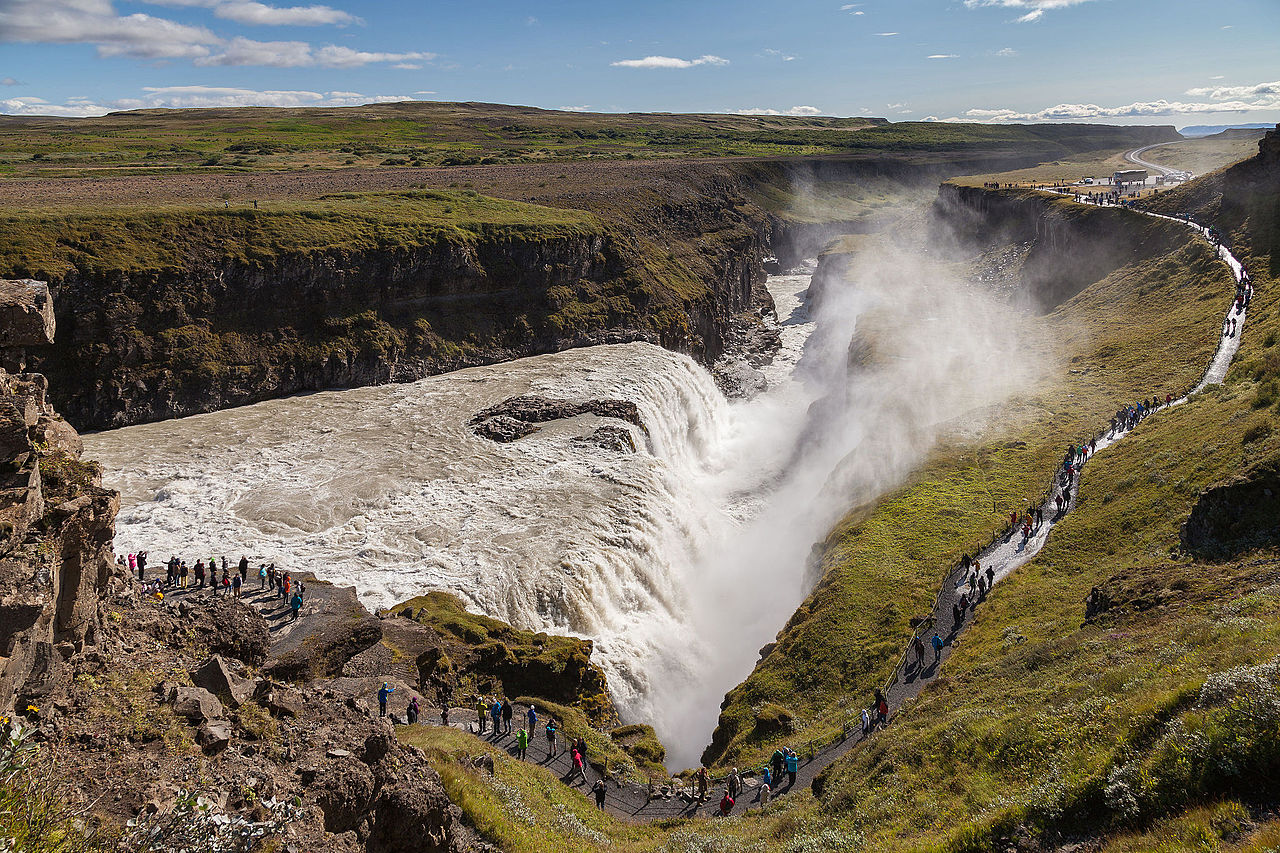
A short drive east brings travelers to the Haukadalur geothermal valley, home to the Great Geysir—the historic fountain spring that gave the English language the universal word “geyser.” While the Great Geysir erupts infrequently, its immediate neighbor, Strokkur, erupts reliably every six to ten minutes, propelling a column of superheated boiling water and sulfurous steam thirty meters into the sub-Arctic air. Further east, the Hvítá (White) River plunges into the jagged chasm of Gullfoss (“Golden Falls”). Fed by the melting ice of the Langjökull glacier, the river cascades across two stepped rock tiers—an eleven-meter upper drop followed by a twenty-one-meter lower plunge—before disappearing into a narrow seventy-meter-deep canyon. In the early twentieth century, local farmer’s daughter Sigríður Tómasdóttir fought a courageous legal battle against foreign industrial developers who sought to dam the river for hydroelectricity, threatening to throw herself into the falls to preserve the natural wonder, establishing herself as Iceland’s first environmental activist.
Glacial Giants and Catastrophic Floods: Vatnajökull and Jökulsárlón
Dominating the southeastern quadrant of the country is Vatnajökull, Europe’s largest ice cap by volume. Covering seventy-nine hundred square kilometers—nearly eight percent of Iceland’s total land area—the ice cap reaches a maximum thickness of one thousand meters, draping several of the island’s most volatile subglacial volcanic centers, including Grímsvötn, Bárðarbunga, and Kverkfjöll. When magma erupts beneath the massive ice sheet, heat melts billions of liters of subglacial ice, trapping immense subglacial lakes until water pressure lifts the glacier ice off the bedrock, releasing catastrophic flash floods (jökulhlaups) that sweep across vast coastal outwash plains (sandurs), carrying house-sized icebergs and volcanic silt into the Atlantic Ocean.

At the southern foot of Vatnajökull lies the Jökulsárlón glacier lagoon. Formed only in the 1930s as the Breiðamerkurjökull glacier tongue began to retreat inland due to atmospheric warming, the lagoon has grown into a deep inland fjord measuring nearly eighteen square kilometers, with depths plunging to two hundred and fifty meters—making it the deepest lake in Iceland. Colossal icebergs, calved directly from the terminal ice face, float across the calm turquoise water like sculpted crystalline monuments. The ice displays intense hues of sapphire blue—caused by centuries of extreme glacial pressure expelling air bubbles from the ice crystals—streaked with black layers of volcanic ash deposited by ancient historical eruptions.
As tides ebb, icebergs drift through a narrow river channel under the coastal Ring Road bridge, washing out into the Atlantic surf. Wave action washes translucent chunks of ice back onto the jet-black basalt sand of Breiðamerkursandur, widely known as “Diamond Beach.” Here, glistening ice blocks of all sizes sparkle in the low northern sun against the obsidian volcanic sands, slowly melting back into the sea.
The Volcanic crossroads: From Laki to Fagradalsfjall
No nation on Earth lives in closer dialogue with volcanism. Iceland’s historical memory is indelibly etched by volcanic events that have altered global history. In June 1783, the Laki volcanic fissure in the southern highlands tore open across twenty-seven kilometers, erupting along one hundred and thirty craters over eight devastating months. The eruption produced fourteen cubic kilometers of basalt lava and discharged over one hundred million tons of sulfur dioxide into the atmosphere, causing the “Mist Hardships” (Móðuharðindin). Toxic fluorides poisoned pastures, killing eighty percent of sheep and half of all cattle; the ensuing famine claimed a quarter of the human population of Iceland. The sulfurous aerosol cloud drifted across Europe, disrupting weather patterns, causing extreme continental winters and crop failures that contributed directly to the social unrest preceding the French Revolution of 1789.
In modern times, Icelandic volcanism captured global headlines in April 2010 when the subglacial volcano Eyjafjallajökull erupted. An abrasive volcanic ash plume ascended nine kilometers into the jet stream, paralyzing European civil aviation for six days and stranding millions of international travelers. More recently, beginning in March 2021, the Reykjanes Peninsula southwest of Reykjavík entered an active rifting episode after eight hundred years of dormancy. Repeated fissure eruptions at Fagradalsfjall, Sundhnúkur, and around the coastal town of Grindavík have demonstrated that Iceland remains an actively growing landmass, where new crust is forged continuously from the glowing core of the planet.
Green Power and Geothermal Society
Rather than viewing geothermal heat merely as a natural hazard, Iceland has transformed its volcanic basement into the foundation of a modern green economy. Today, Iceland is one of the only countries in the world whose electricity and building heating are generated one hundred percent from renewable resources: roughly seventy-three percent from hydroelectric dams tapping glacial meltwater rivers, and twenty-seven percent from high-enthalpy geothermal power plants.
At geothermal fields like Hellisheiði, Svartsengi, and Krafla, engineers drill production wells thousands of meters into fractured basalt reservoirs, tapping high-pressure steam at temperatures exceeding three hundred degrees Celsius. The steam drives turbine generators to produce clean electricity, while hot effluent water is piped along insulated transmission lines directly into homes, schools, and offices in Reykjavík and regional towns, supplying ninety-nine percent of all domestic space heating and tap water. In the greenhouses of Hveragerði, geothermal heat enables commercial cultivation of tomatoes, cucumbers, bell peppers, and flowers beneath artificial lighting through dark Arctic winters.
Geothermal energy has also shaped the social soul of Iceland: the public geothermal swimming pool (sundlaug). Every town and rural hamlet maintains its own heated municipal pool and communal hot tubs (heitir pottar), kept at temperatures between thirty-eight and forty-four degrees Celsius. The sundlaug serves as the community town square, where citizens of all backgrounds—politicians, professors, fishermen, and pensioners—soak together year-round in wind, snow, and rain, debating current politics, weather patterns, and literature in a display of egalitarian social bonding.
The Sagas and Linguistic Continuity
If geology forms the body of Iceland, the Icelandic language (íslenska) forms its heart. Because of the island’s extreme geographic isolation and a conscious policy of linguistic preservation (málhreinsun), Icelandic has undergone remarkably little morphological or grammatical drift since the medieval Viking Age. Inflectional noun cases (nominative, accusative, dative, genitive), complex verb conjugations, and ancient grammatical genders remain fully preserved. When new concepts or modern technologies emerge, rather than adopting international loanwords, Icelandic scholars and the official Language Committee create neologisms derived from ancient Old Norse roots: a computer is tölva (a portmanteau of tala, number, and völva, prophetess); a telephone is sími (an ancient word for wire or thread); and a battery is rafgeymir (electricity keeper).
This linguistic continuity connects modern Icelanders directly to their medieval literature. In the thirteenth century, scholar and statesman Snorri Sturluson compiled the Prose Edda and Heimskringla, preserving Norse mythology (Odin, Thor, Loki, and Ragnarök) that would otherwise have vanished from European memory. Alongside the Eddas stand the family sagas (Íslendingasögur)—masterpieces such as Njáls saga and Egils saga—which depict complex moral dilemmas, family honor, and legal combat with psychological realism. Iceland remains one of the most literate societies in the world, publishing more books per capita than any other nation, celebrated each December during the Jólabókaflóð (the “Christmas Book Flood”), when books are exchanged as traditional Christmas Eve gifts and read late into the dark winter night.
Flavors of Sea and Hearth: From Skyr to Hákarl
Traditional Icelandic food was shaped by the brutal necessities of preserving protein through dark, frozen winters on an island that lacked salt pans, indigenous spices, and grain agriculture. The most infamous survival food is hákarl—fermented Greenland shark (Somniosus microcephalus). Because the Greenland shark lacks kidneys, its fresh meat contains high concentrations of toxic urea and trimethylamine oxide. To make it edible, traditional processors bury the butchered shark meat in gravel trenches for six to twelve weeks to allow fluids to drain, followed by four to five months of hanging in open curing sheds where coastal winds dry the meat. Cut into small cubes and accompanied by a shot of caraway-flavored Brennivín schnapps (“Black Death”), hákarl possesses an intense, pungent ammonia aroma and an aged cheese-like profile, consumed during the midwinter feast of Þorrablót alongside boiled sheep’s head (svið) and cured ram’s testicles (hrútspungar).
In everyday modern life, however, Icelandic cuisine is fresh, clean, and dominated by premium wild-caught seafood and dairy. Cold North Atlantic waters yield exceptional Atlantic cod, haddock, Arctic char, and langoustines, landed daily by sustainable fishing trawlers and served within hours of harvest. The national dairy staple is skyr, an ancient cultured dairy product brought to Iceland by Norse settlers over eleven hundred years ago. Made by fermenting skimmed milk with heirloom bacterial cultures and straining out the whey, skyr has the creamy consistency of strained yogurt but is technically a fresh, mild cheese—naturally non-fat, high in protein, and eaten with fresh wild blueberries (bláber) or cream.
Another beloved staple is rúgbrauð (rye pot bread), a dense, dark, slightly sweet rye bread without crust, traditionally baked by placing heavy cast-iron pots containing the batter into boiling geothermal earth near hot springs for twenty-four hours, eaten warm with salted butter and smoked lamb (hangikjöt).
The Sovereign Horizon: Innovation and Island Independence
Following centuries of joint rule under the Kalmar Union and Danish colonial administration, Iceland gained sovereign autonomy in 1918 and declared full independence as a republic on June 17, 1944, at Þingvellir. In the post-war decades, the nation successfully defended its sovereign fishing rights in the North Atlantic through the historic “Cod Wars” against the British Royal Navy, extending its exclusive economic zone to two hundred nautical miles.
Today, Iceland leads the world in gender equality, scientific innovation, and environmental responsibility. In 1980, Iceland elected Vigdís Finnbogadóttir as the world’s first democratically elected female head of state, and the nation consistently ranks first globally in the World Economic Forum’s Global Gender Gap Index. Its modern economy thrives on software development, carbon capture technologies—such as the pioneering Climeworks Orca and Mammoth direct-air capture facilities in Hellisheiði that mineralize carbon dioxide into subterranean basalt rock—and sustainable high-value tourism.
From the moss-covered lava fields of Eldhraun to the glacial lagoons of Vatnajökull and the radiant dance of the northern lights (aurora borealis) over winter fjords, Iceland proves that a small island society can harness the raw forces of fire and ice to build an enduring civilization of enlightenment, literary genius, and democratic liberty.






Share what you know
Been there, grew up there, or know something we missed? Add a comment; corrections with a source are especially welcome.