




Perched on the northwestern shoulder of the Persian Gulf where the desert plains of the Arabian Peninsula meet the marine currents of the northern sea, the State of Kuwait (Dawlat Al-Kuwayt) occupies seventeen thousand eight hundred and eighteen square kilometers of gravel plains, low coastal mudflats, and offshore islands. Bordered by Iraq to the north and west and Saudi Arabia to the south, while facing Iran across open waters to the northeast, Kuwait’s strategic geography is anchored by Kuwait Bay—a deep, sheltered natural harbor that extends forty kilometers inland from the open gulf. In this hyper-arid climate, where summer shade temperatures regularly exceed fifty degrees Celsius and annual rainfall averages less than one hundred and twenty millimeters, human survival was historically secured through daring maritime commerce rather than inland agriculture.
Kuwait’s historical identity is defined by a remarkable duality: it was born as a maritime city-state of master navigators and pearl divers before transforming in the mid-twentieth century into one of the world’s most affluent petroleum powers. Long before oil transformed the skyline of Kuwait City with gleaming glass skyscrapers, Kuwaiti merchants and shipwrights built the largest, most sophisticated wooden merchant fleet in the Gulf. Guided by a spirit of commercial cooperation between the ruling Al Sabah dynasty and prominent merchant clans, the emirate pioneered constitutional governance in the Gulf, establishing an elected parliament and the world’s first sovereign wealth fund while preserving ancient traditions of social dialogue in the family councils of the diwaniya.

The Maritime Cradle: Dhow Fleets and Pearl Diving
In the early eighteenth century, clans belonging to the Bani Utub tribal confederation migrated from central Arabia to the shores of Kuwait Bay, seeking refuge from devastating droughts. Recognizing the natural protection offered by the sheltered bay, they founded a fortified trading outpost, deriving the name Kuwait from the Arabic diminutive kut, meaning a small seaside fortress. Lacking inland freshwater springs or arable soil, the settlers turned outward toward the sea, mastering boatbuilding and ocean navigation to link the desert interior with the lucrative maritime trade corridors of the Indian Ocean.
Kuwaiti shipwrights in coastal boatyards hand-crafted majestic wooden dhows from seasoned Malabar teak imported from western India, building hulls entirely without blueprints using traditional hand tools and coconut-fiber caulking. The most famous design was the boom, an ocean-going double-ended cargo vessel with a sharply raked bow and lateen sails capable of weathering monsoonal seas. Each autumn, hundreds of Kuwaiti booms embarked on monumental nine-month voyages, carrying Basra dates down the Gulf to Muscat, Aden, Zanzibar, and Bombay, returning with timber, spices, textiles, and porcelain.
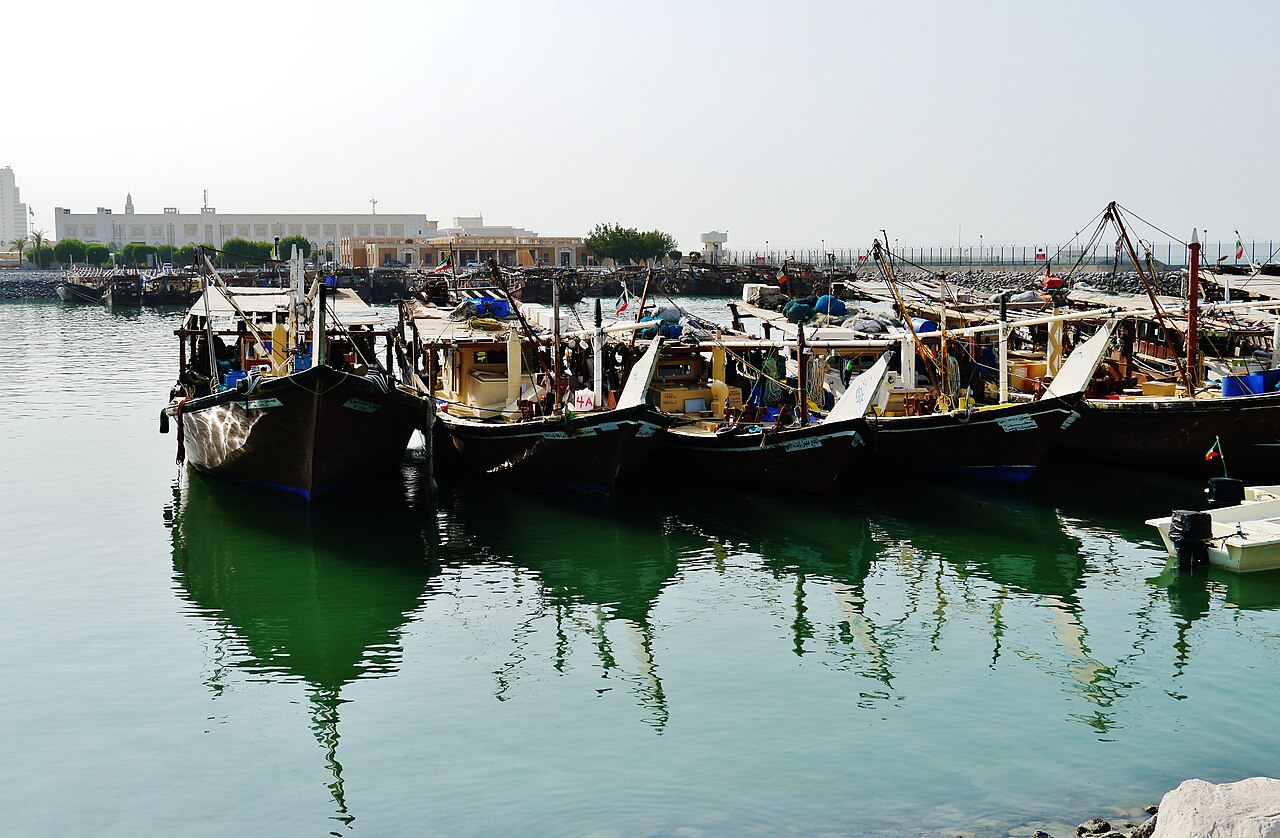
Concurrently, the emirate’s summer economy was driven by the pearl diving season (al-ghous al-kabir). From May to September, up to eight hundred vessels and fifteen thousand men sailed to shallow coral banks (hayrat) scattered across the Gulf. Pearl divers (ghawwas) clipped their nostrils with horn clamps (ftam), placed lead weights on their feet, and plunged thirty meters into the sea on a single breath, collecting oyster shells in woven neck baskets while haulers (suyub) stood on deck ready to yank them back to the surface. It was a perilous profession marked by scurvy, shark attacks, and decompression sickness, yet it generated exquisite natural pearls that supplied luxury jewelers in Paris, London, and Bombay, establishing Kuwait as the commercial capital of the Gulf pearling industry until Japanese cultured pearls collapsed the global market in the 1930s.
Ancient Outposts: Failaka Island and the Bronze Age
Twenty kilometers east of Kuwait City in the entrance to Kuwait Bay lies Failaka Island, the nation’s foremost archaeological treasure. Inhabited continuously for over four thousand years, Failaka served as a vital maritime stepping-stone linking the river civilizations of Mesopotamia in ancient Iraq with the Dilmun civilization centered in modern Bahrain. Archaeological excavations on the island’s southwestern coast have revealed Bronze Age administrative complexes, temple platforms, and hundreds of circular steatite stamp seals depicting horned bulls, gazelles, and maritime merchants, documenting intensive international trade along the Persian Gulf during the second millennium BCE.
Failaka’s significance deepened during the Hellenistic era following the eastern conquests of Alexander the Great. In the late fourth century BCE, Greek settlers established a fortified garrison and colony on the island, renaming it Ikaros after the mythical flier. The site preserves a Hellenistic fortress, workshops, and the Temple of Artemis, where excavators discovered Greek inscriptions, terracotta figurines, and stone steles confirming that Greek soldiers worshipped Olympian deities alongside indigenous Semitic gods on this Gulf outpost, creating a remarkable synthesis of Aegean and Near Eastern cultural traditions.






Share what you know
Been there, grew up there, or know something we missed? Add a comment; corrections with a source are especially welcome.