

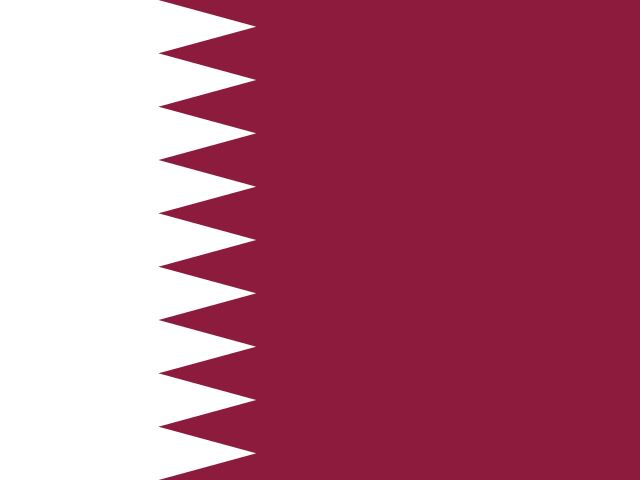

Projecting northward like an outstretched thumb into the central waters of the Persian Gulf, the State of Qatar occupies an 11,586-square-kilometer peninsula anchored to the Arabian mainland by a sixty-kilometer land border with Saudi Arabia. Surrounded on three sides by the warm, hypersaline waters of the Gulf, Qatar looks out toward Bahrain across the Gulf of Bahrain to the northwest and Iran to the north. Across this low-lying limestone shelf—rising to an elevation of barely 103 meters at Qurayn Abu al Bawl in the south—Qatar has evolved from an impoverished eighteenth-century pearling society into an economic and geopolitical powerhouse possessing the world’s third-largest natural gas reserves.
The natural environment of Qatar is characterized by hyper-arid desert topography. The interior is dominated by flat, rocky plains (hamada) covered in wind-swept limestone gravel, punctuated by shallow depression basins (rawdhas) where seasonal runoff deposits fine silt that sustains hardy desert shrubs, and expansive coastal salt flats (sabkhas) that glisten white under the summer sun. Despite extreme climatic conditions—with summer daytime temperatures exceeding forty-five degrees Celsius—the peninsula has supported continuous maritime navigation, nomadic camel pastoralism, and coastal settlement for millennia.
The Inland Sea and Desert Geomorphology
In the southeastern corner of the peninsula lies one of the most remarkable geological formations on the Arabian Peninsula: Khor Al Adaid, known in English as the Inland Sea. Recognized as a UNESCO tentative World Heritage site, this massive tidal marine embayment connects to the open waters of the Persian Gulf through a narrow, shallow channel approximately ten kilometers in length, extending into an inland water body spanning over one hundred square kilometers.
What makes Khor Al Adaid globally significant is the direct physical interface between two contrasting natural systems: colossal barchan and crescentic sand dunes that climb up to forty meters high plunge directly into the turquoise waters of the lagoon. The embayment is hypersaline, with salinity levels often double that of the open ocean due to intense solar evaporation and lack of freshwater river input.

Despite its harsh conditions, the ecosystem of Khor Al Adaid supports significant marine and terrestrial biodiversity. The surrounding waters provide critical feeding and nursery grounds for the vulnerable dugong (Dugong dugon), which feeds on extensive submerged seagrass beds (primarily Halodule uninervis). Qatar supports the second-largest dugong population in the world after Australia, with herds numbering hundreds of individuals congregating in the sheltered southern shallows. On land, the desert fringes are home to the Arabian oryx (Oryx leucoryx)—Qatar’s national animal—alongside desert hedgehogs, Ruppell’s foxes, and osprey nesting on isolated coastal promontories.
Elsewhere on the peninsula, geomorphological features include subterranean karst sinkholes (dahls) formed by the chemical dissolution of underlying gypsum and limestone layers. The most famous is Dahl Al Misfir near Rawdat Rashid, a natural cavern descending over forty meters into the earth, where fibrous gypsum crystals create an ethereal luminescent glow that resembles moonlight on the rocky cavern walls.
Pearling Heritage and the Lost Fort of Al Zubarah
Before the mid-twentieth-century discovery of petroleum and natural gas, Qatar’s economic and cultural life was defined entirely by pearling. For over two millennia, the warm, shallow waters of the Persian Gulf around the Qatar peninsula supported some of the world’s most productive natural pearl oyster beds (fasht). Roman naturalists and medieval Arab geographers, including Al-Idrisi and Yaqut al-Hamawi, praised the luminous quality, spherical symmetry, and delicate pink and cream luster of Gulf pearls.
At the center of this historical maritime economy was Al Zubarah, located on the northwestern coast approximately one hundred kilometers from modern Doha. Founded in the mid-eighteenth century by merchants of the Utub tribal confederation who migrated from Kuwait, Al Zubarah developed into a premier commercial port and pearling hub that rivaled Basra and Bahrain, housing over five thousand residents within its protective perimeter walls.

In 2013, UNESCO inscribed the Al Zubarah Archaeological Site on the World Heritage List, recognizing it as the most complete and well-preserved example of an eighteenth-to-nineteenth-century Gulf merchant and pearling settlement. The site preserves residential courtyard compounds, mosques, industrial date-pressing installations (madbassah), defensive ramparts, and harbor channels. Because the town was destroyed in 1811 during regional conflicts and eventually abandoned in the early twentieth century, its architectural remains were buried and protected by wind-blown desert sand, preserving intact archaeological strata untouched by modern construction.
Dominating the desert landscape near the ruins is Al Zubarah Fort (Qal’at az-Zubarah), erected in 1938 by Sheikh Abdullah bin Jassim Al Thani as a fortified police post to guard the northwestern border. Constructed with traditional one-meter-thick walls made of rough coral rag and beach rock bound with gypsum mortar and coated in protective mud plaster, the square fort is anchored by three circular watchtowers and one rectangular corner bastion, equipped with gun ports that command views of the desert plains and the sea.
Further north along the desolate northeastern coastline lies Al Jassasiya, the most significant rock petroglyph site on the Qatar peninsula. Discovered in 1957, the site features nearly nine hundred individual carvings chiseled into low calcarenite limestone fossil ridges (jebel). The petroglyphs include geometric cup-mark arrangements in parallel rows, rosette clusters thought to have functioned as ancient mancala game boards, and detailed line carvings of traditional seafaring dhows, complete with pointed bows, multiple oars, anchors, and rudder tillers. While the exact age of the petroglyphs remains a subject of archaeological debate, they reflect the ancient maritime relationship between desert dwellers and the surrounding sea.
The annual pearling season, known as the Ghaus al-Kabir (the Great Dive), ran from June through September. Fleets of wooden dhows (such as sambuks and jalibuts) carried thousands of crew members into the open Gulf under the leadership of a ship’s captain (nokhada). Divers (ghwas) descended to depths of twenty meters weighted with stones tied to their feet, using tortoiseshell nose clips (ftam) and holding their breath for up to two minutes while harvesting oysters from reef banks, their safety monitored by haulers (seib) who pulled them back to the surface on a single rope.
Doha and the Revival of Souq Waqif
Along the central eastern coast of the peninsula sits Doha, the national capital and commercial hub that houses over eighty percent of Qatar’s three million residents. In the nineteenth century, Doha (originally Al Bida) was a collection of modest coral stone and mud-brick houses organized around a shallow bay where fishermen and pearl divers anchored their vessels. Following the catastrophic collapse of the global natural pearl market in the 1930s—triggered by the Great Depression and the Japanese development of commercially cultured pearls—the settlement faced economic ruin before oil was struck at Dukhan in 1939.

In the early 2000s, as hyper-modern glass-and-steel skyscrapers began transforming the West Bay financial skyline, Qatar’s leadership launched an ambitious architectural initiative to restore and reconstruct Souq Waqif (‘The Standing Market’). Situated near the historic Wadi Musheireb, where Bedouin traders traditionally gathered with boatsmen to barter goats, wool, and spices while standing at high tide, the modern souq was painstakingly rebuilt to preserve authentic nineteenth-century Gulf architectural vernacular.
Architects removed modern concrete cladding and metal roofs, reconstructing walls from local limestone blocks bound with mud plaster and finished with clay render. Roofs were rebuilt using exposed mangrove timber beams (danshal) imported from East Africa, overlaid with woven bamboo mats (basgail) and layers of palm fronds and clay. Narrow cobblestone lanes are shaded by wooden colonnades, providing natural passive ventilation against the desert heat.
Today, Souq Waqif is the cultural soul of Doha, housing open-air spice alleys filled with fragrant sacks of cardamom, sumac, and dried black limes, alongside carpet merchants, traditional tailor shops crafting gold-trimmed robes (bisht), and artisan jewelers. Within the souq sits the Falcon Souq, a dedicated market catering to the revered traditional sport of falconry (biyazah). Inscribed on the UNESCO Intangible Cultural Heritage list, falconry is an ancient Arabian art; here, prized saker and peregrine falcons rest on wooden perches wearing leather hoods (burqa), while the adjoining state-of-the-art Souq Waqif Falcon Hospital provides advanced veterinary care for the birds.
Qatari gastronomy is intimately bound to desert hospitality and maritime harvests. The national dish is machboos (or kabsa), long-grain basmati rice cooked slowly in a fragrant broth of caramelized onions, garlic, and baharat spice blend—incorporating cloves, cinnamon, coriander, and dried black lime (loomi)—topped with fork-tender spiced lamb, chicken, or fresh sea bream (hamour). In communal majlis gatherings, hospitality begins with gahwa, light-roasted Arabic coffee brewed with freshly crushed cardamom pods and saffron strands, poured from an ornate brass coffee pot (dallah) into small porcelain handle-less cups (finjan) and paired with sweet plump dates. Festive banquets conclude with luqaimat, crisp golden dumplings of fried yeasted dough dipped in dark date molasses and sprinkled with toasted sesame seeds.
North Field and Liquefied Natural Gas Expansion
The contemporary economic reality of Qatar was revolutionized by subterranean geology. In 1971, engineers from Royal Dutch Shell drilling offshore in the waters north of the peninsula struck what initially appeared to be a disappointing non-oil discovery: an immense formation of non-associated natural gas within the Permian-Triassic Khuff reservoir. Named the North Field (which extends into Iranian waters as South Pars), this geological formation was subsequently proven to be the largest single non-associated gas field on Earth, holding over nine hundred trillion standard cubic feet of recoverable natural gas—roughly ten percent of the world’s known reserves.
Under the visionary leadership of the Father Amir, Sheikh Hamad bin Khalifa Al Thani, who assumed power in 1995, Qatar made a colossal strategic gamble. Recognizing that natural gas was difficult to transport without overland pipelines, the state invested tens of billions of dollars in cryogenic liquefaction technology. By chilling methane gas to minus 162 degrees Celsius, its volume is reduced six-hundred-fold, allowing it to be loaded onto specialized insulated cryogenic tanker ships (such as the Q-Max and Q-Flex vessels) and shipped to any energy terminal across the globe.
Operating from the industrial city of Ras Laffan on the northeastern coast, state-owned QatarEnergy developed fourteen massive LNG production trains, propelling Qatar to become the world’s leading exporter of liquefied natural gas. The multi-billion-dollar North Field East and North Field South expansion projects will expand national LNG production capacity from seventy-seven million tonnes to 142 million tonnes annually, ensuring Qatar’s position as a linchpin of global energy security as nations transition away from coal and oil.
Hydrocarbon revenues are managed by the Qatar Investment Authority (QIA), one of the world’s most influential sovereign wealth funds, with assets exceeding five hundred billion dollars. QIA has diversified national capital into landmark international assets, including London real estate (The Shard, Harrods, Canary Wharf), global financial institutions, renewable energy ventures, and major European corporate holdings, securing wealth for generations to come.
Cultural Diplomacy, Architecture, and Sports Leadership
Qatar has channeled its economic wealth into cultural diplomacy and international institution building. In 2008, the state inaugurated the Museum of Islamic Art (MIA) on a purpose-built island in Doha Bay. Designed by Pritzker Prize-winning Chinese-American architect I.M. Pei—who traveled across Egypt, Tunisia, and Spain to study classical Islamic geometry—the museum’s austere limestone blocks and geometric stacked pavilions evoke the thirteenth-century ablution fountain of the Mosque of Ibn Tulun in Cairo. MIA houses fourteen hundred years of Islamic art from across three continents, including illuminated Qur’ans, intricate Persian astrolabes, and Mughal gem-encrusted jade vessels.
Nearby on the waterfront rises the National Museum of Qatar, designed by French architect Jean Nouvel. Inspired by the desert rose—a complex mineral formation of gypsum crystals formed in arid coastal salt flats—the museum’s dramatic interlocking curved disks and sweeping pavilions narrate the trajectory of the nation from geological prehistory and Bedouin nomadic traditions to the pearling era and the modern energy boom.
In November and December 2022, Qatar became the first Arab and Middle Eastern nation to host the FIFA World Cup. The tournament was celebrated globally for its compact geographic footprint and advanced infrastructural engineering, which featured eight architectural stadiums—including Stadium 974, constructed from recycled shipping containers, and the golden Lusail Iconic Stadium—interlinked by the automated Doha Metro and equipped with energy-efficient solar cooling technologies.
Concurrently, Qatar has established itself as an indispensable international mediator in regional and global diplomacy. Following an independent foreign policy grounded in neutrality and multi-vector dialogue, Doha has successfully facilitated peace negotiations and hostage releases between international adversaries, including Afghan peace talks, regional de-escalations across the Levant, and humanitarian prisoner swaps, establishing the small peninsula as a trusted diplomatic forum on the international stage.
The State of Qatar endures as an inspiring synthesis of Arabian coastal heritage and futuristic global ambition, where the wind still carves towering dunes into the waters of Khor Al Adaid, where coral stone fortresses watch over ancient pearl beds, and where visionary stewardship of natural wealth propels an ancient peninsula into the forefront of world commerce and cultural diplomacy.






Share what you know
Been there, grew up there, or know something we missed? Add a comment; corrections with a source are especially welcome.