
Triple Junction Rifting and the Sheba Ridge

Stretching over fourteen hundred kilometers from the rocky headlands of Cape Guardafui to the narrow basalt throat of Bab-el-Mandeb, the Gulf of Aden forms one of the most geologically dynamic ocean basins on Earth. Morphologically, it represents an embryonic ocean basin in its youth, an actively expanding oceanic rift valley separating the Arabian tectonic plate from the Somali plate of East Africa. Rather than being an ancient, static marginal sea, the gulf is a young, widening oceanic limb that began tearing open thirty million years ago during the Oligocene epoch, marking the tectonic breakup of the Afro-Arabian continent.
The Gulf of Aden constitutes the eastern arm of the Afar Triple Junction—the celebrated geological intersection where three major extensional rifts diverge: the East African Continental Rift, the Red Sea Rift, and the Gulf of Aden Rift. At its western apex in the Gulf of Tadjoura, this tectonic boundary transitions from submarine rifting directly into subaerial continental tearing in the Afar Depression, where open volcanic fissures, active basaltic cinder cones like the Ardoukoba volcano, and bubbling hyper-saline lava lakes lie over one hundred meters below sea level. In the enclosed embayment of Ghoubbet-el-Kharab, deep volcanic fault scarps drop vertically into the water, recording the continuous rifting of the Danakil microplate. Eastward across the main body of the gulf, continental crust gives way completely to true oceanic crust along the Sheba Ridge, an active submarine spreading center that links to the Owen Fracture Zone and the Carlsberg Ridge in the central Indian Ocean.
Along the Sheba Ridge, basaltic magma constantly wells up from the upper mantle, rifting the seabed at rates between 1.5 and 2.0 centimeters annually. This ultra-slow to slow spreading axis is segmented by prominent transform faults—such as the Alula-Fartak Trench and the Shukra-el-Sheik Fracture Zone—which slice diagonally across the seabed, creating profound bathymetric abysses where the seafloor drops precipitously to depths exceeding five thousand meters. High-resolution multibeam bathymetry shows that the northern Arabian continental margin and the southern Somali margin are structurally asymmetric, with the northern shelf exhibiting narrow, fault-bounded coastal terraces while the southern margin features broader sediment aprons washed down from the Somali plateau. Hydrothermal venting along these rift walls discharges mineral-rich plumes into the deep water column, nourishing specialized benthic chemosynthetic organisms that thrive along the tectonic seams of this nascent ocean. Seismic reflection profiles across the basin demonstrate that as rifting propagated westward from the Indian Ocean toward the Afar plume, oceanic crust youngs systematically toward the west, providing geologists with a textbook natural laboratory for studying how continents split apart to form new oceans.
Bab-el-Mandeb Gateways and Monsoon Upwelling Dynamics
The physical oceanography of the Gulf of Aden is defined by its role as the hydrographic bridge between the hyper-saline Red Sea and the open tropical expanses of the Arabian Sea. At its western threshold lies Bab-el-Mandeb—the ‘Gate of Tears’—a constricted maritime passage measuring only twenty-eight kilometers wide, bisected by the volcanic island of Perim into the shallow Bab Iskender channel to the east and the deep, navigable Dact-el-Mayun channel to the west. Across the shallow submarine sill of Hanish, measuring only one hundred and thirty-seven meters deep, an extraordinary seasonal two-layer exchange occurs that regulates the thermodynamic properties of both basins.
During the winter northeast monsoon, prevailing southeasterly winds pile up water in the western Gulf of Aden, forcing a thick surface inflow of relatively fresh, warm Indian Ocean water northward through Bab-el-Mandeb into the Red Sea at rates exceeding two to three knots. Beneath this inflow, dense, highly saline Red Sea outflow water (with salinities exceeding 40 practical salinity units and temperatures near 21°C) spills continuously over the sill, plunging down the continental slope into the Gulf of Aden like an underwater waterfall before spreading outward at intermediate depths across the northwestern Indian Ocean.
In summer, the atmospheric engine undergoes a dramatic transformation with the onset of the southwest monsoon. Blistering desert winds sweep northeastward across the Horn of Africa and the Arabian Peninsula, generating intense wind stress curl that drives powerful Ekman transport along the northern coast of Yemen and the northern shores of Somalia. Along the Somali shelf, the boundary current accelerates into the fierce Somali Current, which can exceed speeds of seven knots (3.5 meters per second) and sheds the colossal anticyclonic eddy known as the Great Whirl. This offshore displacement of surface water triggers colossal coastal upwelling. Frigid, nutrient-rich water from depths of two hundred to three hundred meters is forced upward to the surface, causing coastal sea surface temperatures off Mukalla, Shihr, and Ras Fartak to plummet from 30°C to less than 18°C within forty-eight hours. This sudden influx of nitrate and phosphate sparks astronomical phytoplankton blooms, turning coastal waters into rich emerald soup that sustains vast schools of sardines, Indian mackerel, and yellowfin tuna. Large-scale fishing fleets from Yemen, Somalia, and Oman intercept these migrating pelagic shoals as they feed along the sharp thermal fronts, utilizing both traditional wooden dhows and modern purse-seine vessels to harvest hundreds of thousands of tons of high-protein marine food annually.
Coral Oases, Socotra Endemism, and Pelagic Crossroads
Despite experiencing severe seasonal temperature swings and intense upwelling, the marine ecosystems of the Gulf of Aden display remarkable resilience and biodiversity. Along its eastern approaches lies the Socotra Archipelago—a UNESCO World Heritage site often described as the Galápagos of the Indian Ocean. Geologically severed from the African mainland over twenty million years ago, Socotra’s marine realm harbors extraordinary levels of marine endemism, where tropical Indo-Pacific species intermingle with unique regional species that evolved in isolation, such as the Socotra damselfish (Pomacentrus caeruleopunctatus) and specialized wrasses.
Over two hundred and fifty species of reef-building corals flourish around Socotra and along the northern Somali shelf, forming robust fringing reefs dominated by massive Porites lutea, Pocillopora verrucosa, and encrusting brain corals. Unlike many tropical reefs that succumb to coral bleaching when water temperatures rise, corals in the Gulf of Aden have developed exceptional physiological thermal tolerance, conditioned by centuries of exposure to extreme natural temperature fluctuations between sweltering summer highs and frigid upwelling events. Along the barren basalt cliffs of Socotra and the rocky islets of Darsah and Samhah, hundreds of thousands of seabirds nest in massive colonies, including over twenty thousand breeding pairs of vulnerable Socotra cormorants (Phalacrocorax nigrogularis) and red-billed tropicbirds.
In the sheltered embayment of the Gulf of Tadjoura in Djibouti, underwater volcanic vents and nutrient-rich tidal currents create a unique sheltered sanctuary that serves as one of the world’s most critical juvenile whale shark (Rhincodon typus) aggregation sites. Between October and February, dozens of immature whale sharks congregate in the calm coastal shallows to filter-feed on dense swarms of sergestid shrimp and planktonic larvae. The open waters of the central gulf function as a major pelagic migration corridor. Large pods of spinner dolphins (Stenella longirostris), common bottlenose dolphins, and false killer whales patrol the offshore thermal fronts, hunting schooling flying fish and pelagic squid. Solitary pelagic sharks, including oceanic whitetips and scalloped hammerheads, cruise the continental shelf break, while endangered loggerhead, green, and hawksbill sea turtles cross the gulf to reach remote nesting beaches along the untamed coastlines of southern Yemen and the Sultanate of Oman. In coastal lagoons like Khor Umairah in Yemen and the mangroves of Djibouti, dense forests of Avicennia marina provide crucial estuarine nurseries for juvenile tiger prawns and mangrove snappers, binding shifting desert sands against wave erosion.
Frankincense Fleets, Crater Harbors, and Historic Trade
Human maritime history in the Gulf of Aden is among the oldest in recorded civilization, spanning over four millennia of maritime commerce, incense caravans, and imperial conquest. In antiquity, the southern coast of the gulf was the legendary Land of Punt, celebrated by ancient Egyptian pharaohs as the source of aromatic resins, ebony, gold, and live wild animals. By the first century CE, Greek and Roman merchant navigators detailed the maritime geography of the gulf in the Periplus of the Erythraean Sea, documenting active trading ports like Avalites (Zeila), Malao (Berbera), and the great spice emporium of Eudaemon Arabia—the ancient harbor of Aden.
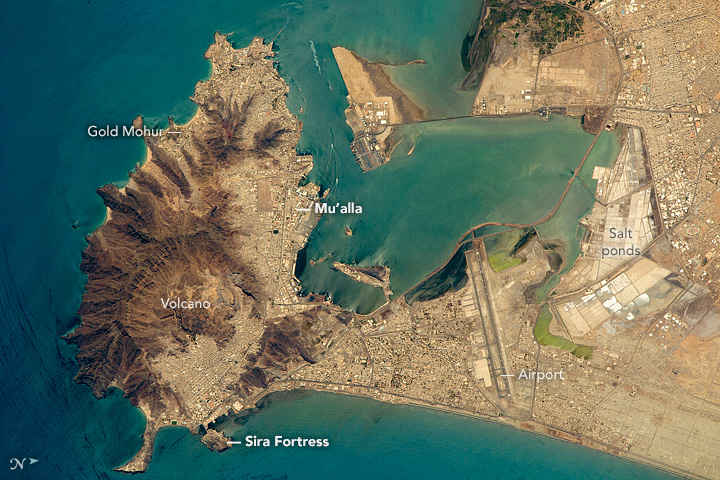
The natural geography of Aden made it one of the most formidable and sought-after maritime anchorages in the ancient world. Situated within the collapsed volcanic crater of an extinct basaltic volcano, the port of Crater and its deepwater roadstead provided secure, sheltered anchorage for trading dhows riding the monsoons between Egypt, East Africa, and the Malabar Coast of India. In the rocky volcanic hills above Crater, ancient engineers constructed the magnificent Cisterns of Tawila—a series of interconnected stone and stucco reservoirs capable of holding tens of millions of gallons of torrential monsoon runoff, guaranteeing a secure water supply for visiting merchant fleets. Here, frankincense and myrrh harvested from the arid limestone hills of Dhofar and Hadhramaut were loaded alongside Indian black pepper, Chinese silks, and African ivory, establishing the gulf as the primary maritime crossroads of the ancient maritime Silk Road.
During the sixteenth century, the strategic dominance of the gulf prompted intense naval warfare between the Portuguese Empire under Afonso de Albuquerque and the Ottoman Empire under Hadim Suleiman Pasha, who conquered Aden in 1538 to secure the maritime flank of the holy cities of Mecca and Medina. In 1839, recognizing the strategic potential of this natural harbor, the British Empire under Captain Stafford Bettesworth Haines of the East India Company captured Aden, making it the first imperial acquisition of Queen Victoria’s reign. With the opening of the Suez Canal in November 1869, Aden’s strategic value exploded. Transformed into one of the world’s busiest coaling stations and bunkering ports at Steamer Point, steamships transiting between Great Britain and colonial India called at Aden around the clock to load coal, take on fresh water, and receive telegraphic dispatches, cementing the Gulf of Aden as the indispensable linchpin of global maritime transport. Along the Somali coast, historic trading ports like Berbera hosted legendary seasonal camel fairs, where nomadic pastoralists traded tens of thousands of livestock and aromatic gums with Gujarati and Arab maritime merchants aboard fleets of ocean-going baghlahs.
Maritime Security, Subsea Cables, and Marine Conservation
In the twenty-first century, the Gulf of Aden represents one of the most strategically critical, economically indispensable, and geopolitically contested maritime waterways on Earth. Approximately twenty thousand commercial ships—carrying over ten percent of the world’s seaborne petroleum and billions of dollars in containerized cargo—traverse the gulf annually, navigating the internationally designated Internationally Recommended Transit Corridor (IRTC). Between 2008 and 2012, a dramatic surge in armed piracy launched from the impoverished, conflict-torn coast of Somalia threatened global supply chains, prompting an unprecedented multinational naval response. Coalitions including the European Union Naval Force (Operation Atalanta), NATO, the US-led Combined Maritime Forces (Combined Task Force 151), and independent naval deployments from China, India, and Japan instituted armed convoy escorts, airborne surveillance, and onboard private armed security teams, effectively suppressing pirate hijackings across the corridor.
Beneath the keel of these commercial fleets lies another dimension of immense strategic value: the global telecommunications infrastructure. The seabed of the Gulf of Aden hosts more than a dozen critical submarine fiber-optic cables—including major global trunk systems like SEA-ME-WE 3, 4, and 5, AAE-1, and 2Africa. These submerged optical lines transmit over ninety percent of all intercontinental data traffic between Europe, the Middle East, and the Asia-Pacific region. Anchored across submarine trenches and volcanic ridges, these cables face persistent hazards from dragged ship anchors, underwater seismicity along the Sheba Ridge, and regional political instability, underscoring the gulf’s vulnerability as a physical choke point for the modern global internet.
Simultaneously, the unique marine ecosystems of the Gulf of Aden require urgent conservation stewardship. Regional environmental organizations, including the Regional Organization for the Conservation of the Environment of the Red Sea and Gulf of Aden (PERSGA), are working to establish transboundary marine protected areas, monitor coral resilience against global warming, and combat illegal, unreported, and unregulated (IUU) foreign industrial fishing along the vulnerable Somali shelf. Advanced satellite tracking and autonomous surface drone networks operated by regional coalitions are increasingly deployed to deter illegal trawlers and protect endangered sea turtle nesting grounds. Community rangers in Puntland and Somaliland are partnering with international non-governmental organizations to restore mangrove buffers and establish community co-managed marine protected zones, offering coastal youth sustainable livelihoods in eco-tourism and artisanal handline fisheries. Protecting this historic waterway demands harmonizing international security cooperation with marine biodiversity preservation, ensuring that the ancient crossroads of the Gulf of Aden remains secure and ecologically resilient for centuries to come.
Frequently Asked Questions
Where is the Gulf of Aden and what bodies of water does it connect?
The Gulf of Aden is an arm of the Indian Ocean located in the Middle East and the Horn of Africa. It lies between the southern coast of the Arabian Peninsula (Yemen) to the north and the Horn of Africa (Somalia and Djibouti) to the south. In the west, it narrows to the strategic Bab-el-Mandeb Strait, which connects it to the Red Sea and the Suez Canal maritime route. In the east, it opens freely into the Arabian Sea between Cape Guardafui on the Somali coast and the island of Socotra.
How did the Gulf of Aden geologically form?
The Gulf of Aden represents an embryonic oceanic basin created by continental rifting between the Arabian tectonic plate and the Somali (African) plate. Rifting began approximately thirty million years ago during the Oligocene epoch as part of the broader Afar Triple Junction system, where the East African Rift, the Red Sea Rift, and the Gulf of Aden Rift meet. True seafloor spreading initiated roughly eighteen million years ago along the Sheba Ridge, an active mid-ocean ridge that continues to generate fresh basaltic oceanic crust and widen the gulf by 1.5 to 2 centimeters each year.
What is the Bab-el-Mandeb Strait and why is it strategically critical?
The Bab-el-Mandeb Strait (meaning ‘Gate of Tears’ in Arabic) is a narrow maritime choke point measuring approximately twenty-eight kilometers wide, separating Djibouti and Eritrea in Africa from Yemen on the Arabian Peninsula. It serves as the sole maritime conduit connecting the Indian Ocean via the Gulf of Aden to the Red Sea, the Suez Canal, and the Mediterranean Sea. Nearly twelve percent of total global seaborne trade and millions of barrels of crude oil pass through this strait daily, making it one of the most heavily trafficked and geopolitically scrutinized waterways on the planet.
How does water exchange occur between the Gulf of Aden and the Red Sea?
Water exchange through the shallow sill of Bab-el-Mandeb undergoes a dramatic seasonal reversal driven by the Indian Ocean monsoons. In winter, strong southeasterly winds push fresh, nutrient-rich surface water from the Gulf of Aden into the Red Sea, while an underlying outflow of dense, super-saline Red Sea Deep Water cascades over the sill into the Gulf of Aden abyss. In summer, intense northwest winds over the Red Sea reverse the surface flow, pushing surface water back into the gulf while an intermediate layer of cool, nutrient-rich Gulf of Aden water intrudes into the southern Red Sea.


Share what you know
Been there, grew up there, or know something we missed? Add a comment; corrections with a source are especially welcome.