
In Bagru, a paste used to print cloth begins with black mud, flour waste, lime and tree gum. The mixture is trampled for hours, rested overnight and strained before it reaches a printing block. Its job is to keep dye out.[11] The pale part of the finished pattern can be the place where someone did the most work.
Bagru is one stop in a wider journey through Rajasthan’s making traditions in India. In Jaipur, blue-pottery painters work on a shaped glaze-ready surface; in Molela, makers build terracotta figures from clay; at Bassi, a storyteller opens a painted shrine panel by panel.[3][5][8] The materials change. So does the person who completes the object’s purpose.
The route follows a change in who takes over. A printer applies a pattern; a potter gives a vessel its painted surface; a maker prepares an image for a shrine; a storyteller decides when each painted panel appears.[2][3][6][8] These are not stages of one production line. They are separate practices, joined here by the way each finished object depends on another person’s skill or use.
A pattern made by keeping colour out
Bagru’s textile printing is associated with Chhipa communities who settled near Jaipur. Cloth once made for local users carried colours and motifs connected with community and status. The production later reached changing markets, while techniques including dabu, or mud-resist printing, continued.[1] A familiar pattern can therefore hold both an older social meaning and the history of a new customer.

For dabu, the paste protects selected areas while the surrounding fabric takes colour in a dye bath. The Craft Revival Trust’s documentation records the work of preparing that paste in Bagru: mixing, trampling, resting and straining before printing can begin.[11] The apparently empty part of the pattern has been deliberately made. The colour and the resist depend on one another.
Direct printing follows another route. An outline block establishes the main design; further blocks add the infill. The process recorded in a 2010 craft-sector study uses long, padded tables, with fabric pinned or laid across them. A block is one tool within a larger arrangement of prepared cloth, colour trays and working surfaces.[2]
Each impression has to meet the last one cleanly. The printer aligns the block, presses it into the prepared cloth and repeats the movement along the length, keeping the border or pattern in rhythm.[10] The work is repetitive, but not mechanical: a small shift can interrupt a line, while a well-placed impression lets the pattern continue without drawing attention to the join.[2] The 2010 craft-sector study describes the outline and infill as separate stages, each asking the maker to keep the design in register.[2] The finished repeat hides the individual decisions that made it possible.
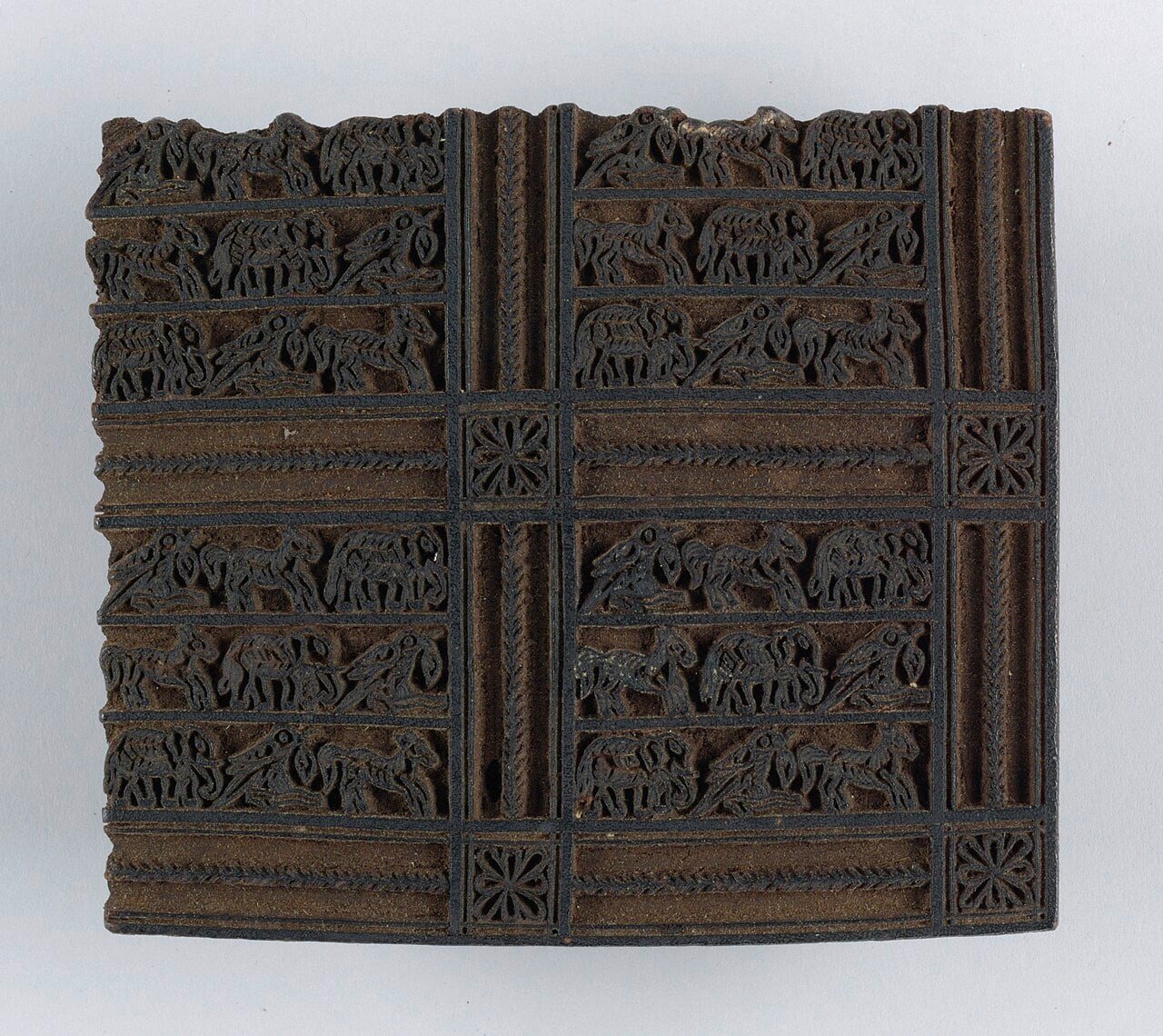
Different blocks can have different jobs within one design: outline, fill or resist. The 2010 study describes seasoned sheesham wood carved to the customer’s requirements, then prepared before use.[2] A carved block carries a design that must remain usable through repeated handling. Its hard face has to deliver a controlled impression to something soft and flexible. The tool’s preparation belongs to that exchange, well before anyone can judge the printed repeat.
A ruler and a piece of chalk have places beside the carved block. Chalk guidelines help position the impressions; a scale checks spacing. The qualification’s equipment list makes this quiet geometry explicit. Pattern has to be measured as well as recognised, especially when another impression must meet the first.[10]
Training also begins before printing: inspect the cloth, wash and preprocess it, stretch and pin it to the table, choose the blocks and prepare the colour tray. Reporting defective material is part of the job. These steps give a printer a chance to solve a problem while it can still be prevented, instead of discovering it across a finished length.[10]
Printed cloth carries a long preparation into a brief moment of contact. What happens afterwards matters just as much. Colour must be fixed, excess material washed away and the textile dried and finished before it becomes the object a customer recognises.[2] The press of the block is the most conspicuous action in a much longer working day.
The work beyond the printing table
A black printing colour can begin with iron and jaggery left in liquid, then further processed with tamarind-seed flour. Other preparations use plant products, minerals or synthetic pigments. The 2010 baseline study records several recipes and substitutions in the workshops it examined.[2] “Natural” is too broad a word to explain this chemistry, and the date of the observations matters. Those recipes are evidence of particular production, not a guarantee about every textile offered for sale today.
Indigo adds another stage to resist printing. Cloth may be dyed lightly before the resist is applied, then dipped again for a deeper surrounding shade. The protected areas keep a different colour history from the unprotected ones.[2] A finished pattern can hold several visits to a vat, even though its surface offers no numbered account of them.
The national textile mapping describes a craft changing with its markets, including chemical dyes, screen printing and shifts away from some older local products. It also records block makers as a community with its own history of migration.[1] The printer, carver and buyer need different things from the same patterned cloth. Change can begin at any point in that relationship.
Occupational-health researchers looked beyond finished textiles to water, equipment and the strain of repeated work. Their recommendations included better ventilation, lighting, rest periods and tool design.[2] Those concerns belong inside the account of craftsmanship. The beauty of a repeat does not reduce the need for a safe table, clean water or a manageable working day.
The link between preparation and appearance continues in Jaipur. There, the material beneath a painted pattern is very different: a quartz-rich body that is shaped in moulds, worked by hand and transformed in a kiln.
The body beneath Jaipur’s blue
Jaipur blue pottery starts with a mixture that can include powdered quartz, glass, Fuller’s earth, gum and other ingredients. It behaves differently from ordinary wheel-thrown clay. Moulds provide an initial shape, after which the piece needs further handling and finishing.[3][4] Its smooth surface is an achievement made before the brush arrives.
In the documented process, powdered materials are ground and sieved, then mixed with water into a workable body. The mould establishes the form; trimming and surface preparation follow.[4] A bowl’s edge has to be resolved as carefully as its broad interior. The repeated shape still leaves individual work to do.
Colour turns that prepared body into the familiar object. Cobalt supplies blue, while other oxides extend the palette. Birds, animals and plant forms occupy vases, bowls, boxes and other pieces.[3] The craft’s name can make blue seem like its only characteristic. Material, form and preparation are equally distinctive.
Kripal Singh Shekhawat, a painter and muralist, helped revive Jaipur blue pottery in the twentieth century. He taught the craft and brought new attention to its distinctive glazed forms.[3]
The Rajasthan craft department also describes adaptations in the product range. Tea sets and small household objects joined established decorative forms.[3] A craft associated with one city can change what it makes while remaining recognisable through its materials and painted surfaces. The next test comes when the object enters the kiln.
When the workshop has to wait
The blue-pottery process ends with glazing and firing, after the separate tasks of shaping, finishing and painting. Photographic documentation follows these stages through to completed products.[4] The painter’s work has to endure a transformation that happens beyond the reach of the brush.
Firing introduces a different kind of uncertainty. The craft-sector study describes the risk of a piece cracking or failing to produce the intended colour. It records a slow cooling period to avoid rapid temperature changes.[2] Time spent waiting is part of production too. A finished vessel can conceal both the labour already invested and the pieces that did not survive.
Rajasthan’s blue pottery is often described through its appeal as a gift or decorative object.[3] Its small scale can be deceptive. A compact bowl passes through several hands and stages of preparation; a painted line rests on all the decisions beneath it. The buyer sees the result of those stages together.
Farther south in Molela, the relationship between a surface and what rises from it becomes more explicit. The backing slab remains visible around a modelled figure. The object’s form also answers to a particular destination: a shrine and the people who worship there.
A deity with a destination
Molela, in Rajsamand district, is known for terracotta plaques made in hollow relief. Prepared clay becomes a slab, while coils and pinched details build the image above it. Figures of deities share the craft’s repertoire with village scenes and newer subjects.[5] A relief combines the flat field of an image with the volume of sculpture.

The Indian intangible-heritage inventory records votive plaques under the name Hingan. Its account connects Kumhar makers with patrons from Bhil, Mina, Garasiya and other communities. Some groups travel with a bhopa, a ritual specialist who helps identify the deity appropriate to a family.[6] Choosing an image is itself knowledgeable work.
Clay is mixed with materials including rice husk and donkey dung, then modelled, dried and fired. Mineral colours and a locally made lacquer finish the plaques described in the inventory. Dev Narayan appears with his characteristic snake symbol.[6] The figure has a recognisable identity, with details that matter to the people who will install and worship it.
The same inventory describes plaques kept in village shrines and replaced after a period of use.[6] Their purpose includes a continuing relationship between a family, a community and a deity. A replacement does not erase the knowledge involved in selecting or making the earlier one. It calls on that relationship again.
A customer buying for a room or gallery may bring another set of expectations. The handicrafts department records contemporary scenes, including classrooms and doctors, alongside religious subjects.[5] Makers can address new audiences through skills developed for older uses. That choice belongs to the makers, with consequences for what they model next.
A family teaches the raised form
Mohanlal Chaturbuj Kumhar practised and taught Molela’s murtikala within his family and village. His sons Dinesh and Rajendra also took part. Sakshi Gambhir’s field documentation for IDC at IIT Bombay records their work and the development of secular panels alongside devotional images.[7] The names restore a human scale to a style often presented as anonymous folk craft.
Gambhir’s account traces how panels of everyday scenes helped open another direction for the craft, including compositions that gathered previously separate subjects together.[7] A workshop could keep the relief technique while changing the relationships between the figures. Inherited skill supplied a way to experiment.
The construction begins below the details that first attract the eye. A slab has to support raised forms; the design emerges through added coils and modelling, followed by drying and firing.[5] The hollow structure described in the heritage inventory is part of this material intelligence.[6] What looks solid from the front can have an unseen interior.
Such knowledge travels through instruction as well as sale. A patron carries away a plaque, while an apprentice carries away a sequence of actions. In Bassi, another craft makes that distinction especially clear: the wooden object goes to a storyteller, who gives it a life the carpenter alone cannot supply.
The door that waits for a storyteller
A Kaavad is a portable painted shrine with hinged panels. Makers known as Basayati Suthars build it in Bassi, in the Chittorgarh area. Kaavadiya Bhats or Ravs, storytellers associated with Marwar, open its panels while narrating stories and the genealogies of their patrons, or jajmans.[8] The object connects people who perform different kinds of work.
Nina Sabnani studied those relationships through fieldwork, filmed performances and conversations with makers and storytellers. Her research followed the interaction of physical structure, narration and audience.[8] A Kaavad holds a story in more than one sense: paintings give it subjects, while doors give the performer a way to control the order in which they appear.

When panels open, a listener’s family history can join a wider sacred narrative. Sabnani interprets the recitation as an experience of symbolic pilgrimage, with genealogy connecting patrons to ancestors and divine figures.[8] A person can travel through a story without leaving the place where it is being told.
The hinge makes that movement possible. One panel conceals another until the narrator chooses to open it. The audience receives a sequence rather than the entire painted field at once.[8] The carpenter’s decision and the storyteller’s timing meet in a small piece of moving wood.
Satyanarayan Suthar continues this practice as an artist from Bassi. Queensland’s gallery collection describes Kaavads made for stories from the Ramayana and Mahabharata, local deities and patrons’ genealogies. It also records newer motifs, including cars, aeroplanes and computers.[9] The painted world can admit things that earlier makers never encountered.
The place prepared for someone else
Bagru’s resist pattern only appears when the cloth is dyed and washed; Molela’s plaque takes its place in a shrine; a Kaavad’s painted panels wait for a storyteller to open them.[11][4][6][8] In each case, the maker’s work anticipates another person’s use. That is the thread linking the crafts, even though their materials and purposes remain distinct.
Satyanarayan Suthar’s panels can place a computer beside older subjects.[9] The image changes, but the storyteller still controls what appears and when. One door opens; the next remains shut until the story is ready for it.


Share what you know
Been there, grew up there, or know something we missed? Add a comment; corrections with a source are especially welcome.