
The crumbs in a fireplace at Shubayqa 1 were older than farming. Excavators working in the Black Desert of northeastern Jordan recovered charred food remains from a stone-lined hearth. Under the microscope, some showed the structure of bread-like products made from ground plants. They dated to roughly 14,400 years ago.[1] People had gathered ingredients, reduced them, mixed them and cooked them before fields of domesticated wheat supplied a reliable harvest.
The discovery did not reveal a village waking each day to a bakery. Its authors describe cereals as a small part of the Natufian diet and suggest that these laborious foods may have had a special role.[1] Between a charred crumb and a daily loaf lies a great deal of work. A woman building an oven, a household saving dough and a farmer choosing seed each solves a different part of that problem. The bread carries the results together.
The fireplace kept a little of the preparation
Amaia Arranz-Otaegui and colleagues published the Shubayqa results in 2018, after excavation led by Tobias Richter. Identifying the small blackened remains required criteria for separating bread, dough and porridge.[2] A burnt lump does not announce its recipe. The researchers examined plant tissue and the structure left by preparation, including the small spaces inside the fragments.
Some remains contained cereal tissue; others also included tissue thought likely to come from club-rush tubers, Bolboschoenus glaucus. The products appeared dense and probably unleavened.[1] Wild grain was therefore not necessarily the only ingredient. Gathering food could involve selecting and combining different plants, followed by grinding, sieving and mixing. The work was already complex even if the finished product was flat.
Grinding tools extend the preparation history further back. At Ohalo II, beside the Sea of Galilee, traces of wild cereals on a grinding stone connect people with plant processing around 23,000 years ago.[3] That evidence concerns the handling of grain; it is not another loaf with a surviving recipe. Each kind of remain answers part of the question, from the tool that crushed a seed to the fragment that records cooking.
Richter suggested that the effort required to produce bread might have encouraged cereal cultivation. The Shubayqa team’s account presents that as a possibility to investigate.[2] It would make desire for a food part of the story of farming, rather than place bread automatically after agriculture. The crumbs establish that the order could run differently. They leave the scale and frequency of that early bread-making open.
Wild wheat lets go of its own seed
Wild emmer, Triticum dicoccoides, has a reproductive habit that makes sense for the plant and creates work for a harvester. Its ripe head breaks apart, releasing the seed-bearing pieces. Domesticated forms retain the head more readily, so the grain can be collected before it scatters.[4] A change that helps people gather a crop alters the plant’s relationship with the ground beneath it.
That difference separates more than two shapes of wheat. A wild population persists by dispersal; a cultivated crop depends increasingly on people collecting and resowing it.[4] Harvesting, storing and planting become connected tasks. Grain intended for flour and grain kept for another season have different destinations even when they begin in the same field.
The Shubayqa remains belong on the earlier side of that long history. Their makers could process wild plants skilfully without depending on a domesticated crop.[1] Farming later changed the supply of ingredients and the amount of labour that could be organised around them. An oven still needed fuel and dough, but a harvest could make their preparation part of a more regular household rhythm.
Wadad Nawaja’a builds the heat into the ground
When Muzna Bishara visited Wadad Nawaja’a in Susya, south of Hebron, she found an oven-maker continuing work learned through her family. Bishara’s account, published in 2022, describes Wadad mixing suitable soil with water and chopped straw, then building the taboon gradually as the layers dried.[6] The oven began as handled earth. Its maker had to allow for what the material would do as water left it.
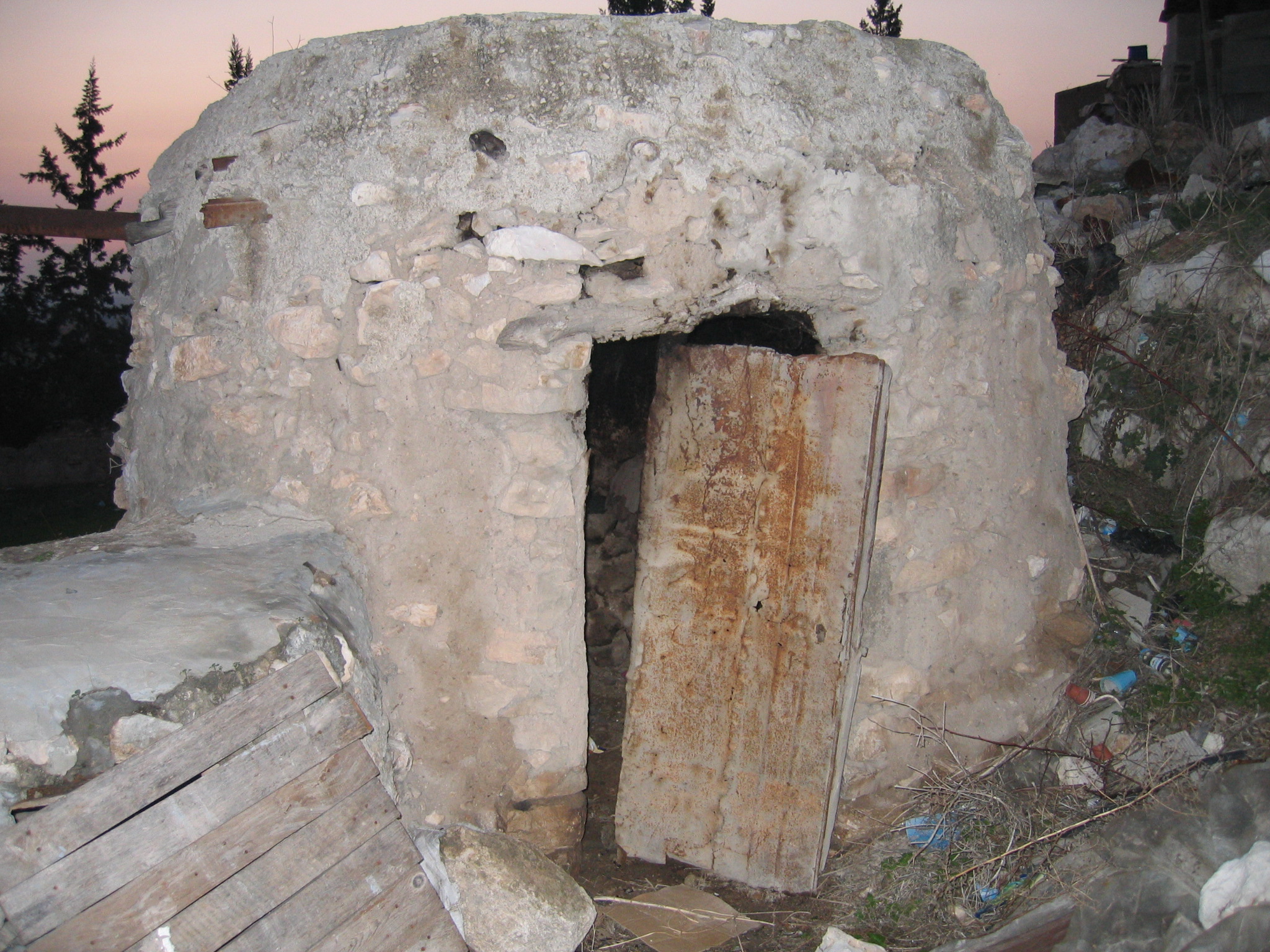
The finished oven in that account is a low clay structure with a lid. Beneath it, a pit holds materials including broken glass and salt to retain heat. The baking surface carries stones against which the dough will rest.[6] The visible shell is only part of the equipment. Some of the work of storing warmth happens below it, where the baker has prepared the ground.
Ovens in the region do not all share that design. Archaeologist Noor Mulder-Heymans documented an experienced maker at Ghezlania in Syria building a tannur from clay mixed with reinforcing materials. Bread in that upright oven adheres to the inner wall.[7] In a tabun, it lies on the hot floor stones.[5] A change in the surface used for cooking changes how the baker handles the same yielding dough.
Measurements of a single oven cannot establish a regional standard. Wadad’s construction, the Syrian tannur and other field examples show people adapting material, fuel and working space to a particular practice.[6][7] The names are a beginning. The arrangement of the hearth, the wall and the bread explains what the name means in use.
Last night’s fuel prepares tomorrow’s bake
A tabun is heated from outside its clay shell. Fuel surrounds the covered oven, and a slow burn transfers warmth into the structure and its foundation.[5] In Wadad’s practice, olive waste or dried animal waste supplies that heat. Bishara describes the oven being fed and covered for the next day’s baking.[6] The baker is preparing tomorrow’s cooking before there is dough on the stones.
The fuel is part of the surrounding agricultural life. Olive processing leaves a residue; livestock provide dung that can be dried. The Asif exhibition on bread in Ottoman Jerusalem connects the taboon’s usefulness with limited supplies of firewood.[8] The oven makes heat from materials already produced by other work. Baking therefore joins the olive press, the animal yard and the household in one sequence.
Smoke also affects where the work can happen. Bishara describes taboons in small structures outside living quarters and notes the effects of smoke and smell.[6] The yard separates the fire from the home while keeping the oven close enough for daily use. A household’s cooking arrangements include these decisions about exposure and distance, as well as the shape of the oven itself.
Older ovens are harder to reconstruct from what remains. Mulder-Heymans discusses an eleventh-century BCE tannur at Tel Hadar, built from clay with other materials in a courtyard.[7] Alexander Zukerman’s study of Bronze Age baking trays examines another kind of evidence: low ceramic forms commonly interpreted as equipment for flatbread.[18] A hearth, a tray and a clay wall can survive differently. They record several ways to apply heat, rather than a single unbroken oven design.
A little dough can begin the next batch
The Shubayqa fragments were probably unleavened. A much later account of Palestinian taboon bread describes leavening with a piece kept from an earlier batch.[1][9] These are separate pieces of evidence. The older crumb does not supply a continuous history of a starter, and the modern account does not explain when fermentation first entered Levantine bread-making.
A sourdough culture contains yeasts and lactic acid bacteria. Their activity changes the dough: yeast fermentation produces gas, while bacterial activity contributes acidity and flavour.[10] Saving some dough can carry that living community into the next mixture. The practice joins one bake to another through a small material that the household deliberately keeps.
That continuity requires feeding, time and suitable conditions. The saved piece is not a permanent charm that works unchanged regardless of how it is treated. It is part of a biological process.[10] The baker makes room for that process before the dough reaches the oven. Clay and stones manage heat; the culture helps determine what kind of dough will meet them.
Jade George and Hisham Assaad’s account also describes commercial yeast in current taboon preparation.[9] An oven can remain recognisable while the method of raising its bread changes. A family need not preserve every stage in one fixed form for the bread to retain a local name. The history is made of decisions within a working practice, including decisions that save time.
The stones leave their impression
At Abtaa in Syria, Mulder-Heymans observed one woman baking for several families who brought their own dough. The oven session joined separate households around one baker and one heated surface.[7] The practical unit was larger than a kitchen. Fuel, equipment and skill could serve a group, while each family still supplied the bread it intended to eat.
When dough is laid over the stones, the uneven surface shapes the loaf. Bishara’s account describes the impressions left in Wadad’s bread, along with the smoky character of food cooked in her oven.[6] A finished loaf can preserve contact with the equipment that cooked it. The marks are formed by the floor, rather than added as decoration afterwards.
The same oven can be used for more than bread. Meat and slowly cooked dishes appear in the account of Wadad’s practice.[6] Once heat has been accumulated, the household can put it to further work. The oven’s value includes the cooking time available after the most urgent baking is done. Maintaining the fire and foundation supports several uses.
In the Asif exhibition, Jerusalem baker Russell Zacks worked with thick flatbreads and pebble-baked forms associated with the city’s history.[8] Such reconstructions are acts of present-day baking informed by records. They let flour, dough and equipment be tested together. Their importance does not depend on pretending that a reproduced loaf is an excavated one.
The saj turns the cooking surface outward
A saj offers another arrangement: a domed metal griddle over a fire. In Mulder-Heymans’s fieldwork, it was associated with Bedouin baking and had replaced tannurs in some places she visited. She suggested lower cost and fuel use as possible reasons for that change.[7] The explanation remains tied to her observations, rather than a claim that every household in the Levant changed equipment at once.
The thin bread made on the griddle has several regional names, including markook and shrak. Dough is stretched over a cushion and transferred to the curved hot metal.[11] The baker handles a broad sheet whose shape depends on stretching before contact with the heat. The movement differs from placing a thicker round over pebbles or pressing dough against an oven wall.

In Jordan, thin bread also forms part of mansaf. UNESCO’s account describes meat cooked with a yogurt-based sauce, served with rice or sometimes bulgur over bread and brought to a shared platter.[12] The bread is part of a meal organised for people eating together. Its thinness and position beneath the other ingredients give it work to do beyond being a separate loaf.
Related flatbread traditions extend beyond the Levant. UNESCO’s multinational listing includes different breads made in a tannur, on a saj or in a cauldron, with preparation and sharing forming part of their social meaning.[13] Common equipment can connect practices without making their names, recipes and occasions identical. The surface is one part of the tradition, alongside who prepares the food and for whom.
Hourani is a seed history, not just a flavour
A study of Jordanian wheat landraces by Abdel-Ghani, Duwayri and Kafawin found a collection dominated by durum wheat, with Hourani particularly prominent.[14] The name belongs to an agricultural history before it appears in a baker’s description. Farmers keep and exchange seed, and populations acquire differences through the conditions under which they grow.
In Syria, Mario Pagnotta and colleagues studied Haurani across different growing regions. Nearby populations tended to be genetically closer, a pattern the authors connected with farmers exchanging seed.[15] The crop’s distribution therefore records human relationships as well as climate and soil. A seed packet moves between people before its plants become part of a field.
The landrace also entered breeding work. In an ICARDA programme, Haurani was crossed with the line Jori to produce Omrabi through selection.[16] That relationship is specific: it identifies material used in a particular breeding history. It does not mean that every old regional wheat survives unchanged inside every modern variety. Nor can evidence from one country stand in for what happened to seed elsewhere.
The Asif exhibition describes efforts to recover heritage wheat and bake with it, including work by Hagay Ben Yehuda and Hussam Nasser.[8] Bringing a grain back into use requires more than keeping its name. Someone must grow it, harvest it, mill it and learn what its flour will do in dough. The distance from a seed collection to a loaf is measured in seasons of work.
Stored seed went back into the ground
War disrupted ICARDA’s work near Aleppo. Its genebank could no longer continue all the growing and distribution needed to maintain access to its collections. In 2015, it requested seed back from the Svalbard Global Seed Vault, making the vault’s first withdrawal.[17] The cold store became useful because its contents could leave again.
The returned material included wheat, barley and dryland grasses. The purpose was to regain the capacity to multiply and supply seed.[17] Storage protects a reserve; cultivation produces another generation that people can use. A frozen sample and a growing field have complementary roles. Neither can replace the other indefinitely.
That need reaches back to the difference between grain for eating and grain for sowing. A portion held back from the flour supply makes another crop possible. The modern genebank handles that task on a different scale, with catalogues, cold stores and an international network.[17] The stored seed still has to become a living plant before it can replenish the collection or supply another field.
A stamp identifies the loaf in a shared oven
In Ottoman Jerusalem, communal ovens and neighbourhood bakeries served households without ovens of their own. Families could mark dough with stamps so that their bread remained identifiable among other loaves.[8] Sharing the heat did not require losing the distinction between one household’s dough and another’s. A small mark carried that information through baking.
George’s account of Palestinian bread-making likewise describes work shared among women: kneading, shaping and tending the oven.[9] The loaf depends on several tasks reaching the same point together. Dough has to be ready while the cooking surface is hot, and the people using it need an arrangement for taking their turns.
At Susya, Wadad’s oven has to be fed again for another bake.[6] The clay shell, the heat stored beneath it and the stones on its floor are practical parts of that preparation. When the dough comes out, it will carry their uneven impression. The crumb in the ancient fireplace and the marks in this loaf belong to different histories, but both preserve something of the work that made the bread.


Share what you know
Been there, grew up there, or know something we missed? Add a comment; corrections with a source are especially welcome.