
Rice left a clue beneath the tea bushes at Okunoyama. Gen Inoue and his colleagues dug into the soil of the surviving garden among Uji’s Seven Famous Gardens, looking for the beginnings of shade cultivation. In a dark layer, they found microscopic plant remains associated with rice. The pattern supported an explanation: straw laid over the tea had become part of the ground beneath it.[1] A material used above the bushes had left a record below their roots.
The researchers estimated that covered cultivation at this garden could reach back to the first half of the fifteenth century, earlier than the familiar written accounts.[1] The date is an inference from soil, not a record of the first person to cover a field. But it brings a practical act into view. Someone put material between a growing leaf and the light. Over time, that act helped shape the powder whisked in a tea bowl: its colour, its flavour and the work needed to make it.[3]
Before Uji’s leaf became the favourite
Tea in Japan predates the fame of Uji. A court history records tea planting in the capital provinces in 815, while another account from that year describes the monk Eichū serving tea to Emperor Saga.[6][2] The drink was associated with court and religious life long before the production methods used for present-day matcha. Its preparation also changed over time; an early pressed tea was different from powder whisked in hot water.
The monk Eisai brought tea from Song China in 1191. Myōe’s planting at Kōzan-ji in Toganoo, and the later movement of tea to Uji, form part of the official account of cultivation’s spread.[3] The story does not begin with Uji already holding the best reputation. Toganoo tea was once distinguished as honcha, “true tea”, against the tea of other places.[2] Uji had a reputation to build.
Patronage helped it do so. During the fifteenth century, the Ashikaga shoguns favoured Uji and supported gardens associated with powerful families. The sites became known as the Seven Famous Gardens.[4] By the later medieval period, named Uji teas appeared in elite households and rankings.[6] A crop grown in a particular place acquired a social geography: gardens, patrons, merchants and people entitled to receive the best leaf.
The label now reaches beyond the town itself. The agriculture ministry describes Uji tea as originating in designated neighbouring prefectures and finished by Kyoto businesses using the local method.[3][14] A name on a packet therefore joins agricultural land to processing and trade. Uji’s small urban centre is one part of a wider production landscape, rather than the source of every leaf bearing its name.
A frost covering became a growing method
Young tea shoots are vulnerable to frost. In Kenji Haraguchi’s account of the method’s development, growers used readily available rice straw to protect them. The covered tea acquired qualities worth pursuing, and a temporary defence became a way of cultivation.[2] The account connects improvement to a piece of ordinary agricultural material. The roof came before growers could explain all the changes it produced in the leaf.
In honzu cultivation, straw is supported above the bushes. A timber and bamboo framework carries reed screens, with rice straw spread over them to strengthen the shade.[2] The Japan Heritage account connects the reeds to Ogura Pond and the refinement of the technique to the demands of tea masters, including Sen no Rikyū.[4] The field roof brought together materials and preferences from beyond the field itself.
Written chronologies place the established covered method in the sixteenth century.[5] The Okunoyama soil study points to an earlier beginning at that garden. Changes in carbon content, soil colour and rice phytoliths, combined with radiocarbon dating, led its authors toward the early fifteenth century.[1] The two records have different strengths. A text can name a practice; soil can preserve traces of its materials before a surviving text describes it.

Modern coverings often use steel frames and synthetic fabric, which reduce labour compared with preparing natural materials.[7] Before harvest, the covering limits sunlight reaching the growing leaf used for tencha.[3] Growers choose and manage a cultivation method. The object overhead may change while the purpose—controlling the light reaching new growth—remains recognisable.
The harvest still needs somebody’s hands
Shogo Yamazaki produces hand-picked tencha beside the Uji River. In a report of a visit by agricultural officials, he identifies a difficulty that the finished powder does not reveal: finding skilled pickers during the short period when the leaf is ready.[9] A crop’s quality depends on work arriving at the right time. Machines and buildings can remain in place all year; the hands needed at harvest have to be available together.

Yamazaki tells beginners to start with new shoots on lower branches. The instruction appears in the same official report as his account of the business.[9] It is a small, concrete piece of training. A novice is given a place to begin, while the more demanding work remains with people who know how to select the leaf. The knowledge moves from one picker to another through a task.
The report describes his commitment to natural coverings and hand harvesting. Those choices continue a method while also creating practical demands for labour.[9] Keeping a traditional technique is therefore an active business decision, not an absence of change. The grower must organise the work that makes it possible. The shoots collected under the cover are only the first form of the product that will eventually reach the mill.
Shade changes what the leaf keeps
In 1950, Yajirō Sakatō published his identification of a substance in Japanese green tea and named it theanine. His paper gives his address as the Uji Agricultural Improvement Experiment Station and notes a contrast between gyokuro and sencha.[10] What growers had learned to value through cultivation and taste could also become a question for chemical analysis.
Theanine is made in the roots and transported into the leaf. Growing conditions affect its subsequent metabolism and the balance of compounds associated with sweetness, umami, bitterness and astringency. Shading favours the retention of theanine relative to conditions in stronger light.[2] The ministry’s account connects the cultivation method directly to a less astringent taste.[3] The roof alters the growth of the crop before processing begins.
Covered leaves also develop a deep green colour as their chlorophyll content changes. Haraguchi describes compounds whose transformation during heating contributes to the characteristic covered-tea aroma, ōika.[2] Cultivation and processing are therefore linked. A substance retained in the growing leaf can become part of the tea’s aroma only after a later treatment. The mill cannot create those earlier growing conditions after the harvest.
That sequence explains why green powder alone is an incomplete description of matcha. The product is made from processed tencha, with cultivation and preparation preceding the grinding.[15][3] A packet conceals the stages by which a living leaf became a dry material suited to a stone mill. Each stage gives the next one something it can work with.
Tencha goes through the dryer without rolling
The first harvest in the Uji region generally falls from late April into May. Leaf destined for tencha is steamed and then dried without the rolling used for other green teas.[3] Steaming acts quickly on the freshly picked crop. In Haraguchi’s account, it inactivates enzymes that would otherwise allow unwanted changes during processing; cooling follows before the leaf enters the dryer.[2]
The tencha dryer carries leaf through a heated chamber on a conveyor. Too much drying harms colour and aroma; too little leaves an unwanted grassy character. Later separation and refining remove stems and veins and prepare the leaf material for grinding.[2] This is a sequence of judgements about what to preserve and what to take away. The final powder is fine because the work begins well before the stones turn.
A related Uji method takes the leaf in another direction. In 1738, Nagatani Sōen developed the hand-kneading technique associated with sencha: steamed leaf is worked over a heated drying frame, the hoiro.[8] The frame supplies warmth while the hands roll and shape the leaf. The technique joins motion and drying instead of leaving tencha’s leaf unrolled.
The preserved hand-kneading process has named stages, including yokomakuri and itazuri.[8] Their survival keeps a record of bodily work within a trade now equipped with machinery. Gyokuro combines covered cultivation with a rolled-leaf process, while tencha is prepared for milling.[3] One field technique can therefore lead to different products, depending on what happens to the harvested shoots.
A mill produces less powder than its size suggests
Haraguchi describes electric granite mills turning slowly on the production floor. One mill produces roughly forty grams of matcha in an hour.[2] The small output gives the machine a different pace from an ordinary kitchen grinder. A heavy stone can do delicate work, with the rate of grinding forming part of the process rather than simply a limit to be overcome.

The powder travels well beyond formal tea gatherings. Haraguchi’s 2015 paper discusses its use in drinks and processed foods, while explicitly acknowledging the absence of firm national production statistics.[2] The taste and colour developed through a specialised growing method have found other settings. An ice cream or sweet can use the same material without recreating the social arrangements of a tea room.
Distribution adds another layer of work. At the JA Zen-Noh Kyoto centre in Jōyō, raw tea is brought into a market where approved merchants bid. The official visit report describes storage and trading facilities opened in 2022.[9] Leaf moves from individual gardens into a system of evaluation, refrigeration and sale. The growers’ short harvest window is connected to a longer chain of preparation and supply.
Rikyū brought ordinary objects into powerful company
Sen no Rikyū was born in Sakai and studied tea before serving Oda Nobunaga and Toyotomi Hideyoshi. His practice is associated with the wabi aesthetic, small rooms and the adaptation of simple objects for tea.[12] Tai-an, the room at Myōki-an associated with him, gives that smallness a surviving architectural form.[17] A gathering could be intimate while its host remained close to political power.
The relationship with Hideyoshi ended in an order that Rikyū take his own life in 1591. Urasenke’s lineage account acknowledges uncertainty over the reasons for their rupture.[12] The tea master’s association with simplicity should not make the world around him seem uncomplicated. Service, influence and vulnerability existed beside the carefully chosen bowl.
Okakura Kakuzō’s The Book of Tea, published in 1906, presents the room to readers through its practices and objects. Guests approach by a garden path; a low doorway changes how they enter; the arrangement gives each action a place.[11] This is Okakura’s account, written long after Rikyū. Its details belong to an interpretation of tea culture as well as a description of a room.
One of the stories he retells concerns Rikyū and his son Shōan. After the path has been cleaned, Rikyū shakes a tree, letting autumn leaves fall over it.[11] The story’s force depends on the contrast between careful preparation and a final adjustment. It can be appreciated as a transmitted anecdote without treating it as a witnessed scene available in every detail.
The bowl has a maker too
Chōjirō’s hand-built red and black bowls belong to the same history of choosing simple forms. The tourism agency’s account of the Raku Museum presents the commission from Rikyū as a popular tradition, while describing the bowls and the family’s continuing work.[13] A bowl can appear unassuming and still be a deliberate response to a demanding use.
At the Raku workshop, inherited pieces supply models for later generations. The museum’s account emphasises study of those objects rather than a master directly teaching every technique to a successor.[13] The preserved bowl is therefore both a finished work and something from which another maker learns. Its shape carries decisions that can be examined again by different hands.
A tea gathering gives the bowl another role. The guest handles and turns it within an established sequence of preparation and drinking.[16] The kettle’s place also changes with the season, between a sunken hearth and a portable brazier. The objects make room for practical care: water has to be heated, powder prepared and a vessel passed from one person to another.
New tea travels, old whisks are remembered
Uji’s political connections once took tea on a formal journey to Edo. The chatsubo dōchū procession carried jars under the Tokugawa system, with the Kanbayashi family among the suppliers.[5] The movement of a crop became a public display of status. The jars connected a production town with the people entitled to receive its tea.
The later opening of export routes changed the market again. Kyoto’s chronology links the opening of Yokohama in 1859 with the expansion of tea exports.[6] The regional landscape now presented for heritage recognition includes cultivation sites and the buildings and routes of trade, rather than a garden alone.[7] Growing, finishing and moving the leaf all leave places behind.
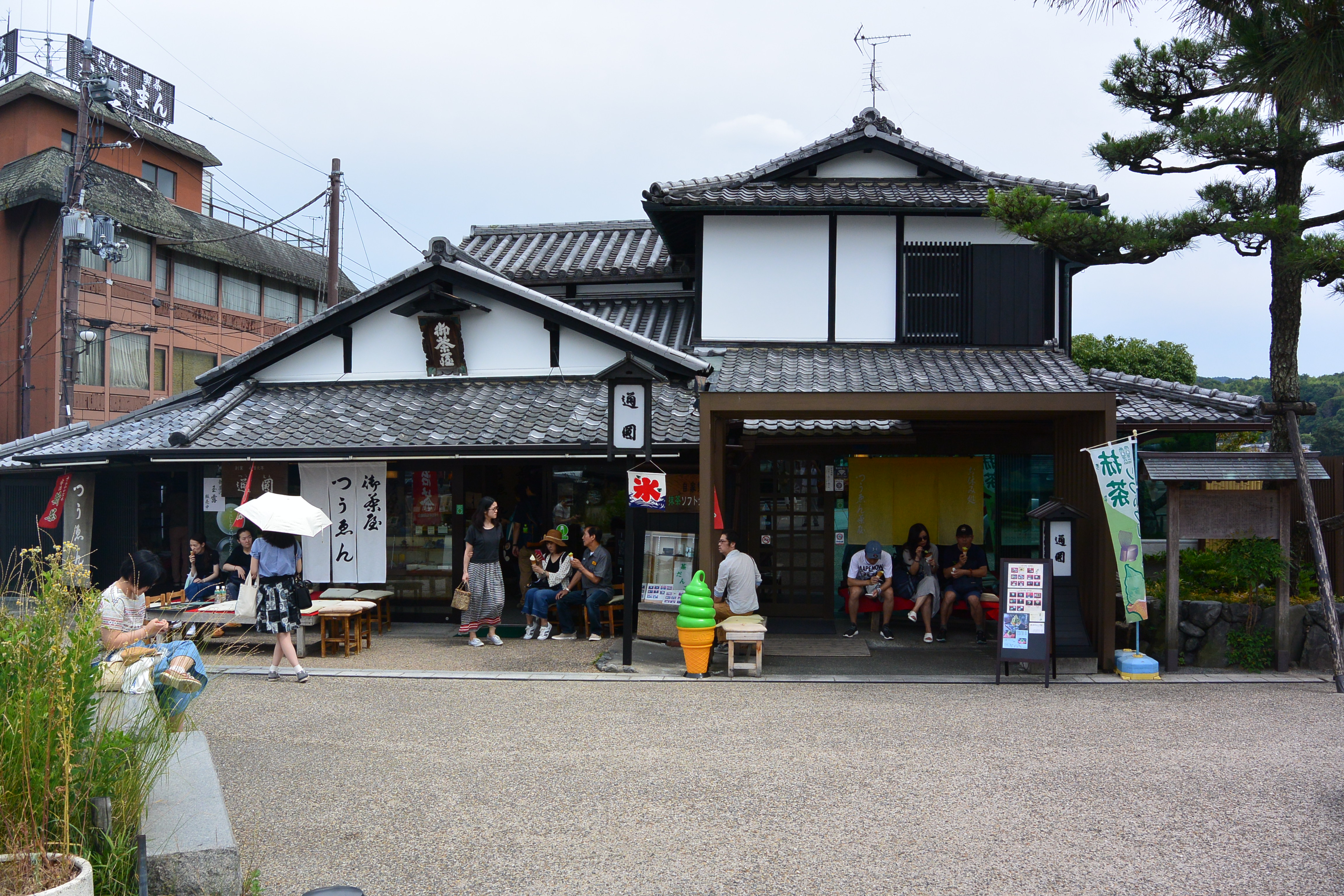
At the Uji Tea Festival, the opening of sealed jars is accompanied by a memorial for worn-out tea whisks. The Japan Heritage account describes water drawn from the bridge and carried in procession to Kōshō-ji.[4] The celebration joins the new crop to objects that have reached the end of their working lives. Both belong to the drink: the leaf that will be prepared and the tool that has already prepared many bowls.
Out in the gardens, the covering must be put up again. Natural reed and straw remain part of the documented regional method, even as synthetic materials have become common.[4][7] Beneath Okunoyama, the soil retains rice phytoliths that researchers interpret as evidence of past use.[1] They do not prove that a particular plant has survived from that time. They preserve traces of the material handled above it.
In Yamazaki’s garden, a beginner is directed toward the lower shoots.[9] The instruction brings the whole sequence back to a reachable branch. Before the steam, the mill and the bowl, somebody has to choose the leaf.


Share what you know
Been there, grew up there, or know something we missed? Add a comment; corrections with a source are especially welcome.