
At Óc Eo in southern Vietnam, a grinding tool carried traces of spices. A 2023 study reports 717 starch grains from 12 implements; researchers identified 604 to species. The grains include evidence for plants such as turmeric, ginger, galangal, clove, nutmeg and cinnamon. They do not preserve a whole meal, but they put plant ingredients beside the equipment used to prepare food.[10] The research team also examined phytoliths and pollen. Their findings combine several kinds of botanical evidence, each requiring identification and comparison before it can support a claim about what people used.
That stone changes the scale of a spice route. A cargo list records goods moving between ports. A grinding surface brings us closer to what someone did with an ingredient after it arrived. Plants travelled; people selected, processed and combined them. The history of a flavour is therefore also a history of work, power and choices made in kitchens.
Black pepper, cinnamon, cloves and nutmeg each began as a different part of a plant. Their trade connected growing places to ports and households, but it never made those places interchangeable. To follow the route, begin with the crop, then look at the people and systems that turned it into something a cook could use.
A grinding stone brings the kitchen into view

The study does not claim that a present-day curry recipe survives unchanged from Óc Eo. Its evidence is more precise: plant microremains were identified on food-processing tools, and some starch grains showed damage consistent with preparation. The researchers connect those finds with early maritime contacts and with culinary knowledge moving between South and Southeast Asia.[10]
That distinction gives the archaeological evidence its strength. A grain is not a recipe, and a tool cannot tell us every movement of the person using it. Together, though, surface and residue show that spices were handled at the site. The grinding stone is not a ship or a ledger. It is evidence of ingredients entering a practical sequence of preparation. That difference matters to the larger story: the route can be reconstructed from cargo, crop and residue, but the eating itself is usually less directly preserved.
Pepper begins on a climbing vine
Black pepper’s botanical name is Piper nigrum. Its fruits grow on spikes along a tropical climbing plant; the dried grains in a kitchen jar are processed fruit, not seeds gathered loose from the ground. Black, white and green peppercorns can come from the same species, with maturity and processing shaping the product.[1][2]


The plant and the jar show different stages. On the vine, fruit is still attached to the growing plant. Dried and prepared, pepper can be weighed, packed and carried. Drying changes the crop into a commodity that can travel beyond the place where it grew. The work of cultivation and preparation comes before the merchant’s account of price or distance.
PROSEA distinguishes black and white pepper commodities from fresh or preserved green pepper, and separates piperine’s pungency from the volatile oils associated with aroma. A cook encounters more than a single property called “strength”; processing and preparation shape what the ingredient contributes.[2]
The Malabar coast of Kerala is among the places closely associated with pepper. Kew identifies Malabar and Tellicherry peppercorns with the region, while PROSEA records the crop’s cultivation and movement beyond southern India. The familiar seasoning thus has a specific growing geography, and the trade begins with a living crop rather than a ready-made sack on a quay.[1][2]
A history told only through ships makes cultivators and processors vanish. Yet a cargo exists because someone grew the vine, gathered its fruit and prepared it to keep. Those steps are less visible than a sail crossing the Indian Ocean, but without them there is nothing for the ship to carry.
Kerala and the Malabar coast give this first strand a place; India connects it to the wider map.
Cinnamon keeps the shape of its preparation
A cinnamon quill is bark rolled into a form that can be dried and stored. Kew distinguishes Cinnamomum verum, associated especially with Sri Lanka, from related cassias that may also be sold under the broad commercial name “cinnamon.” A familiar label can therefore cover different botanical materials.[3]

In the pictured samples, Ceylon cinnamon has thin, closely packed layers; Indonesian cassia has a thicker wall and a more open centre. The millimetre scale makes this comparison visible, though thickness alone is not a test for every product sold under either name.[3]
Kew describes the work that forms the quill: scraping, peeling, layering, rolling, trimming and drying. The tree supplies bark, but the marketable shape records human handling. A whole quill retains some of that structure. Once ground to powder, the layers and rolled form are much harder to recognise.
That practical difference matters at the table, but cinnamon’s history also includes struggles over who could control its sale. Kew traces Portuguese, Dutch and British involvement in Sri Lankan cinnamon. These powers did not discover a plant that local people had never known; they sought authority over an existing crop and its value.[3]
The spice arrives in many kitchens as an ordinary ingredient. Its easy place in a recipe can obscure the contest over production and trade that helped determine who controlled the route and who benefited from it.
Cloves and nutmeg narrow the map
Cloves are dried, unopened flower buds of Syzygium aromaticum. Nutmeg is the seed of Myristica fragrans, and mace is the red lacy covering around it. One fruit supplies two separately named spices, often sold and used apart from one another.[4]

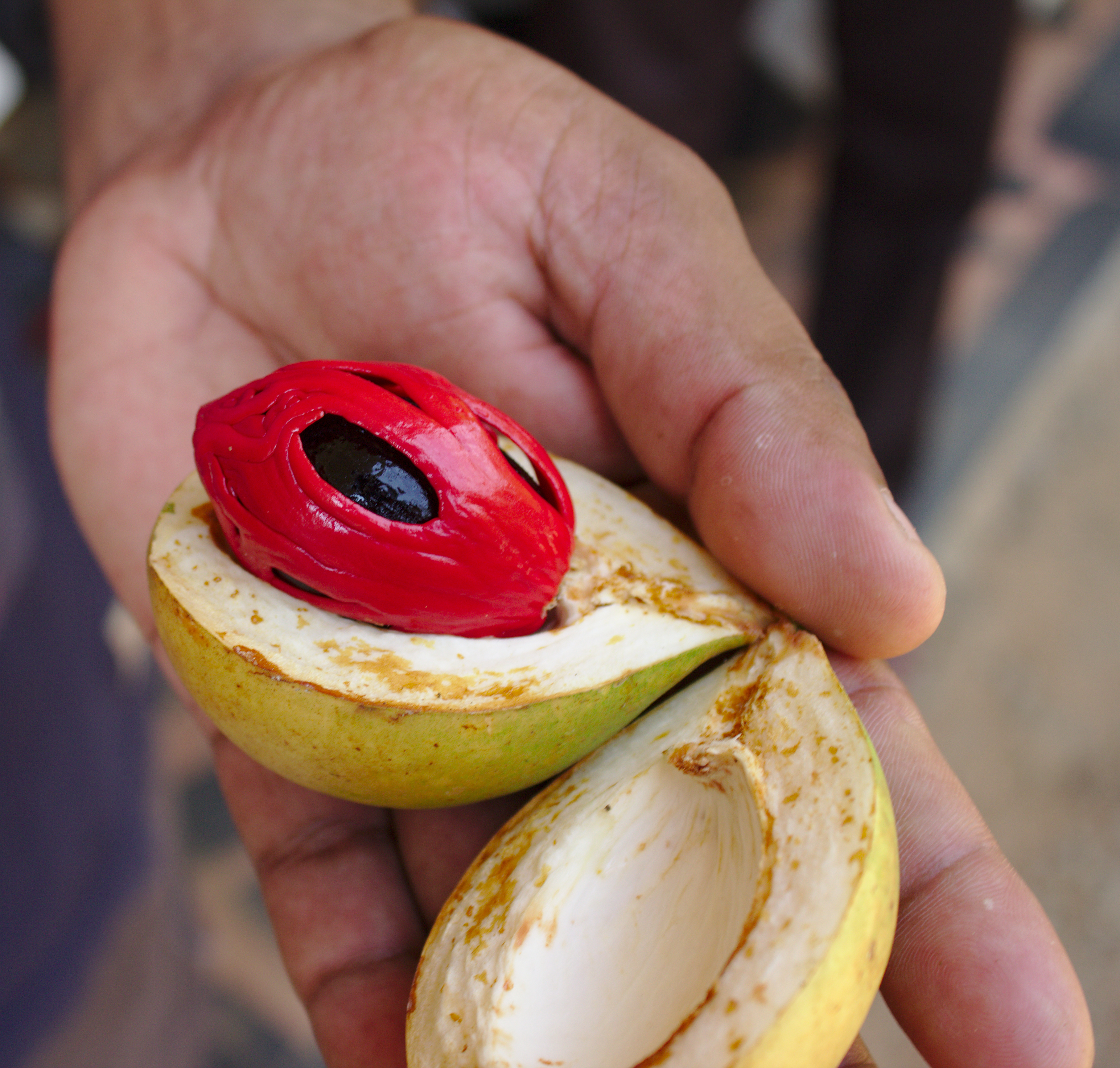
The cloves in the photograph keep their flower-bud shape: a compact head and a narrow lower portion. Kew describes hand-picking and drying the buds. In the opened nutmeg fruit, seed and mace remain together. These small botanical differences point to different tasks between harvest and the familiar spice in a packet.[4]
The Banda Islands were an important source of nutmeg; clove production was associated with the northern Maluku islands. Indonesia’s tentative-list submission describes producing places and trading ports within a wider maritime system. These islands were inhabited places with their own political and economic relationships, not empty dots awaiting outside discovery.[8]
Royal Museums Greenwich describes Asian trading networks already operating before European involvement expanded. European merchants entered an existing commercial world, adding new participants and conflicts to it.[7] A spice route was not one road or one ship’s passage. Goods changed hands, moved alongside other merchandise and passed through ports and relationships that differed by commodity and period.
Monsoon winds made the route seasonal
Project Mausam, led by India’s Indira Gandhi National Centre for the Arts, connects maritime cultural networks with the Indian Ocean’s seasonal winds. Its account describes a broad southwest pattern from May to September and a northeast pattern from November to March. A sailing plan had to take the changing direction into account; the same passage posed different practical conditions in different seasons.[9] The seasonal pattern belongs to the physical geography of the ocean, but it also shaped when crews and merchants could plan a voyage. A line across the water cannot show that rhythm by itself.
A route on a map can look like a line. At sea, it belonged to a calendar. At port, a shipment also had to be gathered, sorted, stored and transferred. Each stage required labour and decisions, from preparing a crop to arranging its onward passage. These activities rarely fit neatly into an arrow labelled “East to West.”[6][9]
UNESCO’s Silk Roads programme describes knowledge, beliefs, techniques and languages moving along with goods. A port was therefore more than a stop between two points: it was a place where commerce met local lives and other kinds of exchange. The particular route depended on the spice, the time and the people conducting the transaction.[6] A port could connect a local market to a wider circuit without making every participant part of one uniform system. The name “spice route” is useful only if it leaves room for these different passages and exchanges.
Banda’s nutmeg trade carried a human cost
In 1621, the Dutch East India Company established a plantation system in Banda after the destruction of much of the indigenous population. Archaeologist Amy Jordan’s study examines the reshaping of life and foodways on the plantations through ceramics, animal remains and starch evidence.[11]
Trade language can flatten this history into “control” and “supply.” Those short words conceal what happened to land and to people’s ability to remain in their communities. Jordan’s research on three plantations finds evidence of multiple subsistence and trade strategies, while also stressing how little direct evidence survives about daily adaptation.[11]
That evidence supports a careful account of foodways under colonial rule. It does not license an invented family meal or a scene of a named worker grinding spices. The record is fragmentary, but its limits do not erase the documented violence that made the plantation system possible. Nutmeg’s later presence in a distant kitchen cannot be separated from the conditions imposed where it was grown.
A nutmeg grater turns trade into a household gesture
The Metropolitan Museum of Art holds an egg-shaped British nutmeg grater dated to about 1780. Enamelled copper forms its case; a removable metal grater let its owner store a whole seed and grate it as needed. The museum places it among small luxury objects through which wealth and taste could be displayed.[12]

The case makes a domestic action visible: keep a whole nutmeg, then grate an amount when it is wanted. The object’s making around 1780 and its later entry into the museum collection as a 2023 gift are separate moments in its history.[12] The museum’s catalogue also records the grater’s material and form, letting us distinguish what the object was designed to do from what its decoration communicated. Use and display fit within the same small case.
A nutmeg can move from a plantation economy to a private possession small enough to hold in one hand. The grater does not tell us the full route or every person involved. It does show how a traded spice became part of a household practice, and how consumption could turn an imported crop into a display of taste.
A recipe records a changing idea of “mince”
The National Archives preserves a recipe dated between 1603 and 1625 for six mince pies. It combines spices, dried fruit and sugar with mutton and veal. The document catches a form of mince pie very different from the sweet pastry many people know today. Its name endured while the filling changed.[15]
This recipe is unusually useful because it is an instruction, not a general claim about the popularity of imported spices. Someone was expected to mix the ingredients, enclose them in pastry and bake them. The spice has a role within a particular preparation, beside meat, fruit and sugar.[15]
Set beside the grater, the recipe moves the story from possession to use. One object records a tool for preparing a spice; the other records ingredients combined for a dish. Neither is a whole kitchen. Together, they show how a commodity’s history continued after a ship had reached port.
Curry debal carries a local recipe into the present
In Singapore, curry debal is a traditional Boxing Day dish in Eurasian cuisine, prepared with Christmas leftovers, according to the National Heritage Board. The name refers to those leftovers in Creole-Portuguese; the English nickname “Devil’s curry” directs attention to its heat.[13]
The Heritage Board’s account lists roast pork belly and a rempah including candlenuts, tamarind, mustard seeds, onions, vinegar, and fresh and dried chillies. It also notes that household recipes differ. The Eurasian Association associates curry debal with Malacca and describes a paste flavoured with candlenuts, galangal and vinegar. Its food account maps dishes to connections with Sri Lanka, Goa, Macau and the Philippines.[13][14]
Those accounts do not need to resolve into one definitive recipe. Their differences are part of the evidence: one community, many family versions, and a range of regional ties. The dish belongs to a specific culinary history, not to an interchangeable idea of “spice” assembled from wherever ingredients happened to travel.
Leftovers make an ungrand ending for a global route. They bring it from port and plantation to the next day’s cooking, where someone decides how to use what remains. Trade helps explain how ingredients became available. The choice of what to combine, and when to prepare it, belongs to cooks and households.
Chilli sends the story west to east—and back again
Chilli unsettles any account that treats spice movement as a one-way story out of Asia. Capsicum peppers originated in the Americas and later became integral to foods far beyond that region. Despite the shared English name, chilli belongs to a different botanical family from black pepper.[5]

The long red fruits in the basket retain their outlines before grinding. A dried chilli and a peppercorn can both become powder, but their whole forms are easy to distinguish. The shared word “pepper” records a naming history, not a botanical identity.[5]
Origin is only a plant’s first chapter. A crop becomes local through cultivation, preparation and repeated use. The familiar place chilli holds in Asian cuisines was made by people over time; it is not cancelled by the plant’s American origin.
The slab at Óc Eo and the curry debal bowl sit far apart in time and place, but each brings the route down to preparation. A plant can cross an ocean as cargo; its meaning is made again at the grinding surface and in the kitchen. The journey ends in a recipe because that is where trade becomes food, through a cook’s own decisions.


Share what you know
Been there, grew up there, or know something we missed? Add a comment; corrections with a source are especially welcome.