



A name made from two languages
Burkina Faso carries its own introduction in its name. Adopted in 1984, it joins Burkina, from Mooré, with Faso, from Dioula: a name often rendered in English as “Land of Upright People.” It is a chosen national ideal, not a description that can be applied to every citizen or a claim that one language or community defines the country. The name replaced Upper Volta, a title for the territory situated upstream in the Volta basin. Those names point in different directions: one expresses an ideal of shared belonging; the other locates the country within a landscape whose waters connect it to a much wider West Africa.[1][reference needed]
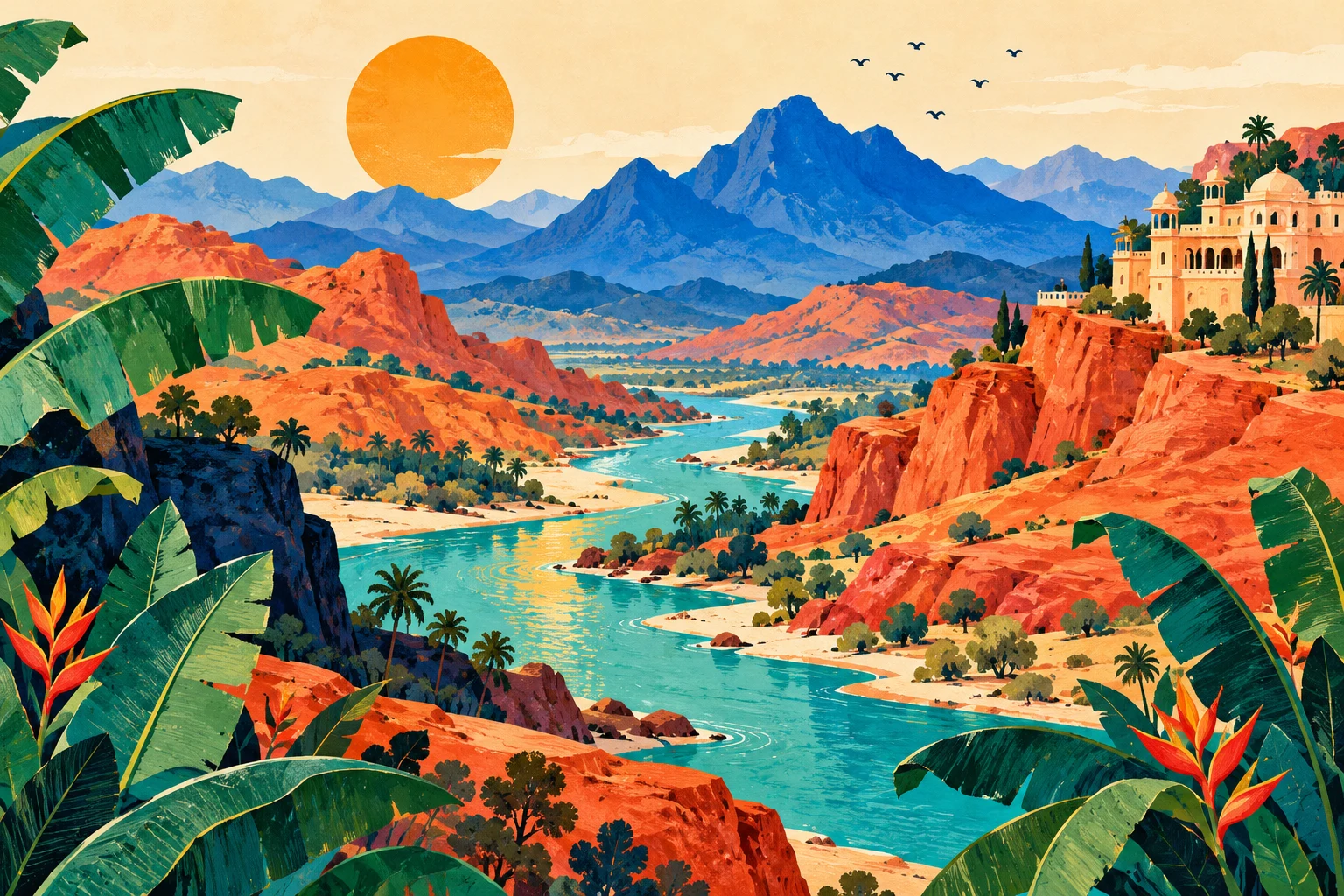
That meeting of languages and waters is a useful way into Burkina Faso. It is a landlocked country in West Africa, bordered by Mali and Niger to the north and east, and by Benin, Togo, Ghana and Côte d’Ivoire to the south and west. The northern reaches sit in the Sahel’s dry belt; farther south, rainfall and vegetation generally increase, passing through open savanna and cultivated country toward woodland. The shift is gradual rather than a simple line on a map. The four national river basins—Comoé, Mouhoun, Nakanbé and Niger—also make clear that this country’s waters flow into systems shared with its neighbours.[3][4]
The rivers are seasonal and heavily shaped by rainfall. The Mouhoun, also known historically as the Black Volta, flows northeast before turning south; the Nakanbé, historically the White Volta, runs through the central part of the country toward Ghana. The Nazinon, once called the Red Volta, is another tributary in the Volta system. Their older English names are not a visitor’s colour chart: they belong to histories of mapping and naming. In the north and east, tributaries feed the Niger basin; in the southwest, the Comoé flows toward Côte d’Ivoire. The Volta rivers continue south through Ghana to the Gulf of Guinea. To live inland here is still to live within a regional water geography, even where a river is far from view.[4][reference needed]






Share what you know
Been there, grew up there, or know something we missed? Add a comment; corrections with a source are especially welcome.