
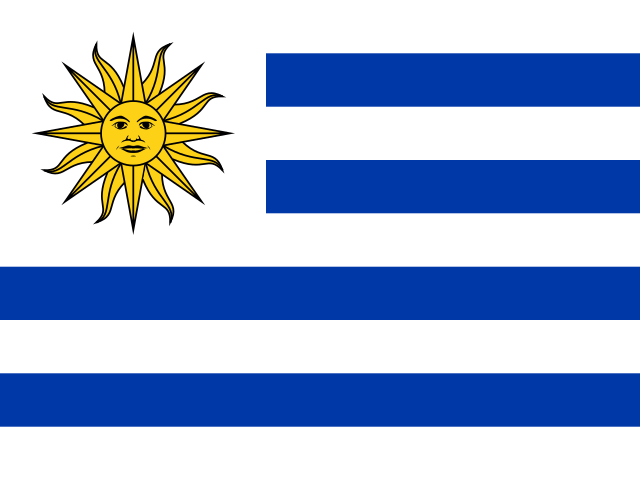

Resting gracefully along the northeastern margin of the colossal Río de la Plata estuary and the southwestern South Atlantic Ocean, the Oriental Republic of Uruguay is South America’s second-smallest sovereign state, yet it exercises an outsized moral and institutional influence across the continent. Spanning 176,215 square kilometers, Uruguay is cradled between two continental giants: Brazil to the north and northeast, and Argentina to the west across the meandering channel of the Uruguay River. Geomorphologically, Uruguay represents a gentle topographic transition between the rolling hills of the Brazilian shield and the endless, horizontal grasslands of the Argentine Pampas. Low, undulating ranges of granite and basalt hills (cuchillas)—such as the Cuchilla Grande and Cuchilla de Haedo—rarely exceed three hundred meters in elevation, culminating at Cerro Catedral at 513 meters. Over three-quarters of the country is covered by fertile natural prairie grasses (campos), drained by an intricate network of waterways including the Río Negro, which cuts diagonally across the national heartland before merging into the Uruguay River.
The human geography of Uruguay is distinguished by its high urbanization, European demographic heritage (predominantly Spanish, Italian, and Basque, alongside a culturally vital Afro-Uruguayan community), and a secular social-democratic compact that has made it the most egalitarian and politically stable democracy in Latin America. Over half of the nation’s 3.4 million citizens reside within the metropolitan orbit of the capital, Montevideo. Here, the absence of sharp social stratification is reflected in a relaxed, communal civic culture: citizens stroll along the expansive waterfront promenade with insulated thermoses tucked beneath their arms, continuously sipping hot mate through silver straw filters (bombillas), sharing conversations in public parks framed by neoclassical and Art Deco architecture.
Bastion on the Estuary: Colonia del Sacramento and the Colonial Duel
Two hours west of Montevideo along the tranquil waters of the Río de la Plata lies Colonia del Sacramento, Uruguay’s oldest European settlement and its premier historical treasure. Founded in January 1680 by the Portuguese governor of Rio de Janeiro, Manuel Lobo, the fortified outpost was established as a strategic thorn in the side of the Spanish Empire, positioned directly across the river from the Spanish colonial capital of Buenos Aires. For more than a century, Colonia was the focal point of a fierce geopolitical duel between the crowns of Lisbon and Madrid, changing hands seven times through naval sieges, treaties, and surprise assaults before finally coming under definitive Spanish control in 1777.

Designated a UNESCO World Heritage site in 1995, Colonia’s Barrio Histórico preserves this volatile contested past in its distinctive urban fabric. Unlike Spanish colonial towns which adhered strictly to the rigid grid plan prescribed by the Laws of the Indies, Colonia’s street network reflects Portuguese organic design: winding, cobblestone lanes paved with rough river stones, equipped with central drainage gutters and framed by thick, whitewashed stone houses with tiled hip roofs. Along the Calle de los Suspiros (“Street of Sighs”), ancient gas lanterns illuminate centuries-old stone facades draped in climbing bougainvillea.
Rising above the ruined masonry of the seventeenth-century Convent of San Francisco stands the historic Colonia Lighthouse. Constructed in 1857 using the stone foundations of the ruined convent, the white cylindrical tower rises twenty-six meters into the coastal air, offering sweeping views across the shimmering grey-brown waters of the estuary toward the distant Argentine horizon. Here, visitors can trace the ancient city walls, pass beneath the heavy wooden timbers of the Puerta de la Ciudadela (the restored city drawbridge), and visit the Iglesia Matriz—the oldest Catholic church in Uruguay, whose thick stone walls weathered multiple artillery bombardments during the transatlantic wars of empire.
The Civic Living Room: Montevideo’s Rambla and Plaza Independencia
In the capital city of Montevideo, urban life is defined and ennobled by the Rambla—a continuous, uninterrupted twenty-two-kilometer paved coastal promenade that stretches along the entire waterfront from the industrial port and Ciudad Vieja past the beaches of Ramírez, Pocitos, and Buceo to the residential suburbs of Carrasco. The Rambla is far more than a physical pathway; it is the democratic living room of Uruguayan society, where citizens of every social class, age, and background gather at dusk to jog, bicycle, fish from the sea walls, or simply sit in contemplation as the fiery sun sinks into the Río de la Plata.

At the western end of the Rambla, bridging the historic colonial Ciudad Vieja with the modern downtown avenue of 18 de Julio, lies Plaza Independencia. The square is dominated by a colossal sixteen-meter bronze equestrian monument honoring General José Gervasio Artigas, the father of Uruguayan independence, below which sits a subterranean granite mausoleum containing his mortal remains, guarded around the clock by ceremonial guards of the Blandengues regiment. Overlooking the plaza stands the architectural icon of Montevideo: the Palacio Salvo. Designed by Italian architect Mario Palanti and completed in 1928, this eccentric ninety-five-meter Art Deco tower—combining Gothic spires, classical arcades, and marine motifs—was briefly the tallest skyscraper in South America, conceived as a fraternal twin to the Palacio Barolo in Buenos Aires.
Plaza Independencia also preserves the historic gateway to the ancient fortified settlement: the Puerta de la Ciudadela, a monumental eighteenth-century granite archway that marks the boundary where the colonial walls were dismantled in the nineteenth century to allow the egalitarian republic to expand. Within the Ciudad Vieja, the Mercado del Puerto, an ornate cast-iron market hall manufactured in Liverpool and opened in 1868, buzzes with the tantalizing aromas of asado—beef, lamb, and chorizo sausages sizzling slowly over glowing embers on colossal tilted iron grills (parrillas), celebrated with glasses of medio y medio (a sparkling blend of dry white wine and sweet sparkling wine).
Casapueblo and the Atlantic Riviera of Maldonado and Rocha
Heading east from Montevideo along the coastline, the gentle river estuary gives way to the open, deep-blue waters of the South Atlantic Ocean. In the department of Maldonado, the rocky granite promontory of Punta Ballena juts boldly into the sea, providing the dramatic setting for Casapueblo. Created over thirty-six years by the celebrated Uruguayan painter, sculptor, and builder Carlos Páez Vilaró, Casapueblo is a monumental “living sculpture” that cascades down the western cliffs of the peninsula like a surreal whitewashed Mediterranean citadel.

Constructed entirely by hand using whitewashed cement, stucco, and salvaged timber without architectural blueprints, Casapueblo was inspired by the organic mud nests of the native hornero bird (Furnarius rufus) and the whitewashed cliff villages of Santorini. The sprawling labyrinth of thirteen levels contains hundreds of curved corridors, sculptural terraces, art galleries, and residential suites. Every evening at sunset, hundreds of visitors gather on the sea terraces for the moving “Ceremony of the Sun,” where Páez Vilaró’s recorded voice recites a poetic eulogy thanking the sun for its warmth and life as it sinks beneath the ocean horizon.
Beyond Punta Ballena lies Punta del Este, South America’s most glamorous international beach resort, renowned for its pristine Atlantic surf beaches, modern high-rise skyline, and Mario Irarrázabal’s famous 1982 public sculpture La Mano (or Los Dedos)—five giant concrete fingertips emerging dramatically from the sands of Brava Beach. Further east still lies the wilder, unspoiled department of Rocha, where sweeping sand dunes, coastal freshwater lagoons (Laguna de Rocha and Laguna Negra), and historic eighteenth-century fortresses such as Santa Teresa and San Miguel protect fragile coastal wetland ecosystems harboring black-necked swans and capybaras.
The Gaucho Heart: Cattle Culture, Yerba Mate, and Candombe Rhythms
While the coast is urban and cosmopolitan, the interior of Uruguay—known simply as el interior—is the domain of the gaucho. For three centuries, the rolling natural grasslands of the pampa sustained vast herds of free-roaming cattle and sheep. The gaucho emerged as a legendary nomadic horseman, famed for his equestrian prowess, rugged individualism, and mastery of the boleadoras (weighted leather cords used to entangle running cattle) and the facón (long fighting knife worn tucked into a wide coin-studded leather belt).
Today, this pastoral heritage remains the beating heart of national identity. Uruguay possesses one of the highest ratios of cattle to humans in the world, with roughly four head of cattle for every citizen. Unlike industrialized feedlot systems, Uruguayan beef is raised almost entirely on open natural pastures without artificial growth hormones or antibiotics, supported by a mandatory, state-managed digital livestock traceability system where every single animal carries an electronic ear tag tracing its lifetime history from birth to slaughter. Every March, tens of thousands of horsemen gather in Tacuarembó for the Fiesta de la Patria Gaucha, celebrating ancestral rodeo skills, traditional guitar poetry (payadas), and communal outdoor barbecue.
Complementing the gaucho ethos is the enduring musical heritage of candombe, an Afro-Uruguayan percussive art form designated by UNESCO as Intangible Cultural Heritage. Developed by enslaved Africans in Montevideo during the eighteenth and nineteenth centuries, candombe is powered by the thunderous polyrhythmic beat of three distinct barrel-shaped drums: the deep piano, the medium chico, and the high-pitched repique. During Carnival season, particularly in the historic neighborhoods of Barrio Sur and Palermo, dozens of drum ensembles (comparsas) participate in the Las Llamadas parade, parading through the narrow streets accompanied by traditional characters such as the Gramillero (an elder medicine man), the Mama Vieja, and the Escobero (baton juggler), filling the nocturnal streets with an infectious, syncopated rhythm that reverberates deep within the chest.
The Kitchen of the World: Fray Bentos Industrial Landscape and Tannat Viticulture
Along the eastern bank of the Uruguay River, one hundred and fifty kilometers north of Colonia, lies Fray Bentos, home to the Fray Bentos Industrial Landscape, inscribed as a UNESCO World Heritage site in 2015. Beginning in 1865 with the founding of the Liebig’s Extract of Meat Company, this colossal river port factory transformed South American cattle production into an industrial empire. Pioneering German chemist Justus von Liebig developed a method to reduce entire bovine carcasses into a concentrated, nutrient-dense paste known as Liebig’s Extract of Meat, followed by canned corned beef under the Fray Bentos brand. Exported across the globe to feed industrial factory workforces and frontline armies during both World Wars, Fray Bentos was heralded as the ‘Kitchen of the World,’ demonstrating how pasture wealth was mechanized and preserved through steam boilers, deep-water docks, and refrigerated slaughterhouses.
Complementing this pastoral industrialism is the singular viticulture of Uruguay. While Argentina is famed for Malbec and Chile for Carménère, Uruguay is the world capital of Tannat, a robust, deeply colored red grape originally brought from the Madiran region of southwestern France by Basque immigrant Don Pascual Harriague in the 1870s. In the clay and calcareous gravel soils of Canelones, Montevideo, and San José, maritime breezes from the Río de la Plata soften the intense summer heat, allowing the thick-skinned Tannat grapes to develop velvety, complex tannins, dark berry aromas, and balanced acidity. Tannat has become the undisputed national wine of Uruguay, served in rustic countryside bodegas and urban bistros as the ideal gastronomic partner for slow-roasted beef asado.
Pioneering Secularism, Renewable Energy, and the Green Transition
Uruguay’s contemporary social stability is grounded in the transformative political reforms of the early twentieth century, spearheaded by visionary president José Batlle y Ordóñez. Batlle established the modern welfare state, enacting an eight-hour workday, non-contributory old-age pensions, free secondary and university education, and universal female suffrage. Crucially, Batlle instituted strict secularism: church and state were constitutionally separated in 1919, religious holidays were systematically rechristened with secular civic names (Christmas became “Family Day,” and Holy Week became “Tourism Week”), and crucifixes were removed from public hospitals, establishing a culture of civic tolerance and rationalist debate that endures today.
In the twenty-first century, Uruguay has extended this spirit of progressive pragmatism to environmental policy, executing one of the most remarkable clean energy transitions on the planet. Facing severe droughts in the 2000s that crippled its hydroelectric dams and forced costly oil imports, Uruguay launched an ambitious national energy policy. Within a single decade, through public-private partnerships and long-term regulatory certainty, the country transformed its electrical grid: today, over ninety-five percent of Uruguay’s electricity is generated from renewable sources, combining hydroelectric power with a massive network of modern wind farms and biomass energy derived from eucalyptus forestry residues.
Uruguay was also the first nation in the world to implement the One Laptop per Child initiative on a universal national scale (Plan Ceibal), providing every primary and secondary school student with a free laptop and internet access, laying the groundwork for a flourishing domestic software and information technology export sector. From the cobblestone alleys of Colonia to the democratic sunsets of the Rambla, and from the verdant cattle pastures of the pampa to the cutting-edge wind turbines spinning against the Atlantic sky, Uruguay endures as a enduring model of human dignity, institutional integrity, and progressive social harmony in the Southern Hemisphere.






Share what you know
Been there, grew up there, or know something we missed? Add a comment; corrections with a source are especially welcome.